
An old guy tries a (relatively) new trick.
We will see how this experiment goes:
http://www.youtube.com/watch?v=40p8UxQHGFo&feature=youtu.be
An old guy tries a (relatively) new trick.
We will see how this experiment goes:
http://www.youtube.com/watch?v=40p8UxQHGFo&feature=youtu.be
Filed under creative solutions
The Hamlet reference in the title comes from our work in senior English yesterday. We were examining Claudius’s dialogue with himself in his private chapel. That speech opens with the painful, confused acknowledgment, “Oh my offence is rank, it smells to heaven” (3.3.36). Since this post is basically about modeling learning, I have flipped his statement–for fun, even though the result sounds more urgent than intended.
On the way to this class, last period Friday, I walked with a senior who had attended a lunch session organized by the Student Diversity Leadership Council. They had invited Frank McCloskey, Vice President for Diversity at Georgia Power. He spoke in the library about his experiences before and in that position, a post he has held for ten years. I would say that about sixty people chose to hear Mr. McCloskey, including this senior, myself and four other students from the last period class. All five of us stayed to the end of the SDLC session, which made us about ten minutes late to class. I consider those ten minutes a valuable investment, for a variety of reasons. For example, our late arrival gave me the opportunity to apologize to the whole class, from which naturally grew the chance for the four students to explain to their classmates where we had been and what we had heard. As each attendee summarized his or her impressions, I had the opportunity to hear that individual response. Afterwards, I added my response. As it turns out, our being late pushed me to do what I had wanted to do anyway–make known to a wider audience the substance of the valuable program.
Anyway, as I was walking to class with this senior, I asked her what she thought of the session. She remarked on Mr. McCloskey’s idea that leaders often influence others in ways they do not realize. As an older sister, for example, she was struck by the notion that her younger sister looks up to her, and follows her model, more than she knows. I think Mr. McCloskey addressed this notion within the context of his topic, “trusted leadership.”
In the next post, I will describe a brief episode, also from yesterday, about modeling learning. More and more, I am convinced of the power of our modeling learning for students. Making mistakes is part of learning; we have to be able to do this, and to let students see us do this. Such transparent modeling gives us the natural opportunity to also show them how we respond to the mistake. For example, how well do we adapt to the unexpected result? In other words, how do we make thinking visible to them, as we learn from our mistakes?
p.s. Our department is discussing “thinking” as a skill. If we reflect on how we make our own thinking visible–to ourselves and our students, we may have opened a window on what me mean by this term. We may have opened a second window–on how we design work that makes the students’ thinking visible. I know I have heard others speak and seen others write on this topic; Project Zero, I think, has done work in this area.
Filed under creative solutions
 As has happened more than once–ask my wife–while walking through a room in our house, I spotted a book. This time it was Wendell Berry’s Standing by Words: Essays (Washington, DC: Shoemaker & Hoard, 1983). I pulled it from the shelf mostly because of yesterday’s post–about not wasting chances to grow something. Passages from Berry’s book have fed me ever since I found it in Durham, NC some years ago. One of its passages I have framed; it hangs in my office at work. It describes the value of discipline. Yesterday’s post about saving radish sprouts made me want to review a few passages I had tagged in the book. I found two to include here.
As some readers may know, Wendell Berry likes to write about farming. In fact, the following excerpts come from his essay called “People, Land, and Community.” I enjoy and appreciate his descriptions of agricultural rhythms, especially in this our increasingly digital world. I find comfort and value in his discussion of time. It simply takes time to grow things, and discipline to stay with the same soil. I am starting to hear echoes of the teaching profession in passages like these below.
“But to think of the human use of a piece of land as continuing through hundreds of years, we must greatly complicate our understanding of agriculture. Let us start a job of farming on a given place–say an initially fertile hillside in the Kentucky River Valley–and construe it through time.
“1. To begin using this hillside for agricultural production–pasture or crop–is a matter of a year’s work. This is work in the present tense, adequately comprehended by conscious intention and by the first sort of knowledge I talked about–information available to the farmer’s memory and built into his methods, tools, and crop and livestock species. Understood inits present tense, the work does not reveal its value except insofar as the superficial marks of craftsmanship maybe seen and judged. But excellent workmanship, as with a breaking plow, may prove as damaging as bad workmanship. The work has not revealed its connections to the place or to the worker. These connections are revealed in time.
“2. To live on the hillside and use it for a lifetime gives the annual job of work a past and a future. To live on the hillside and use it without diminishing its fertility or wasting it by erosion still requires conscious intention and information, but now we must say good intention and good (that is, correct) information, resulting in good work. And to these we must now add character: the sort of knowledge that might properly be called familiarity, and the affections, habits, values, and virtues ((conscious and unconscious) that would preserve good care and good work through hard times” (71-72).
There you are then. One of my marked passages from Wendell Berry’s book. Living on the hillside is like living with the students. Knowledge and memory, affections and patience–we depend on these for results that emerge later, sometimes much later, in time.
photo credit: http://www.havenandhearth.com/forum/viewtopic.php?f=5&t=10185
Filed under beauty, challenge, creative solutions, trust, work
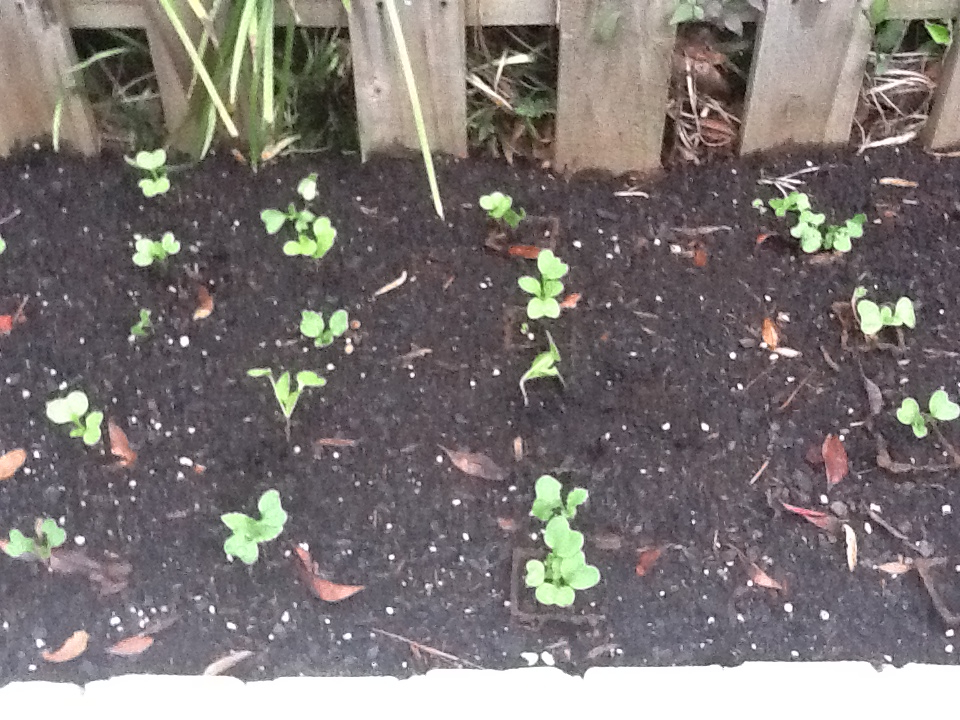 This morning before driving to work, I thinned out the radishes, again. Several weeks ago, I started the seeds in small fibrous cells, letting them sprout in the house–on a tray and under a thin plastic sheet. Once they were ready, I moved the seedlings outside to our wall garden. More than once now, I have thinned them, so that just one plant grows in its own space. Last summer, when we had less garden space, I discarded the thinned seedlings. Now, with the newly prepared larger space, as I pull out and separate tiny strands of radish plants, I can walk them a few feet to my left–to open ground. I enjoyed realizing that I did not have to waste these tiny plants. They have potential to grow into full, pinkish red bulbs that eventually we can rinse, slice and eat.
associative leap (using as a connection the idea of not wasting potential)
Moving the slender plants this morning made me think of today’s school schedule. The spring vacation starts after today, and, as in many schools, we struggle to make the day worthwhile. We try to spend our time together productively, without wasting it. I have occasionally told students that as I age, I become less interested in wasting time. So today, in my sophomore classes, we did an exercise I had been imagining for some time, not sure when or how I would implement it. I will briefly describe it, along with a few fun discoveries.
Basic exercise
As newly appointed interns in the US State Department, prepare a map (with four basic features) of the Dominican Republic for Secretary Clinton and the rest of her staff. I can send you, readers of this blog, the one-page instructions, if you like. For now, just know that we had just finished reading Julia Alvarez’s In the Time of the Butterflies, set in the DR during Trujillo’s oppressive thirty-year rule.
Several discoveries
1. As with most such exercises, the main challenge, especially the day before vacation, was to engage all group members in the map-making process.
2. As groups worked, I monitored progress with Photo Booth, an application on our MacBooks that let me film interactions in each group. During the last five minutes, when I projected the video for everyone, I began to see this filming as a fun, natural way for the students and me to assess varying levels of collaboration within groups. Also, I have a new tool for my assessing the kinds of questions they ask, and just as important, how I answer those questions. Among today’s discoveries, this one excites me the most–partly because I have started reading a book about student questions and partly because I see a natural way to mix student engagement, technological tools and my own self-assessment. The book, incidentally, is called Make Just One Change: Teach Students to Ask Their Own Questions and written by Rothstein and Santana (Harvard Education Press, 2011).
3. The wording of the assignment’s instructions, appearing below a copy of the State Department’s official seal, gave me license to inject a realistic feel to my interactions with the students. In my role as Special Assistant to Secretary Clinton, I could make sure they understood the need to work efficiently together. State Department staff members often need to work on short notice. They need to find, understand and communicate information with efficient collaboration. I like to think that today, when some wish they could waste time, we had fun playing roles and learning more about another country. As one of the team leaders was packing her backpack, she explained where the country’s two major airports are. Out of genuine safety concerns, this student wanted to make sure that Secretary Clinton landed in an appropriate location. You will have to believe me that this girl, on the day before spring break, sounded as if she had suspended her disbelief. Her imagination had taken her authentically into this assignment. What a joy it was for me to hear her speak in this tone, in these terms. We took one person’s potential and planted it in fresh soil.
Filed under beauty, challenge, creative solutions, empathy, expression, imagination, trust, work
 maroonballoon