Category Archives: challenge

home-grown haiku 2

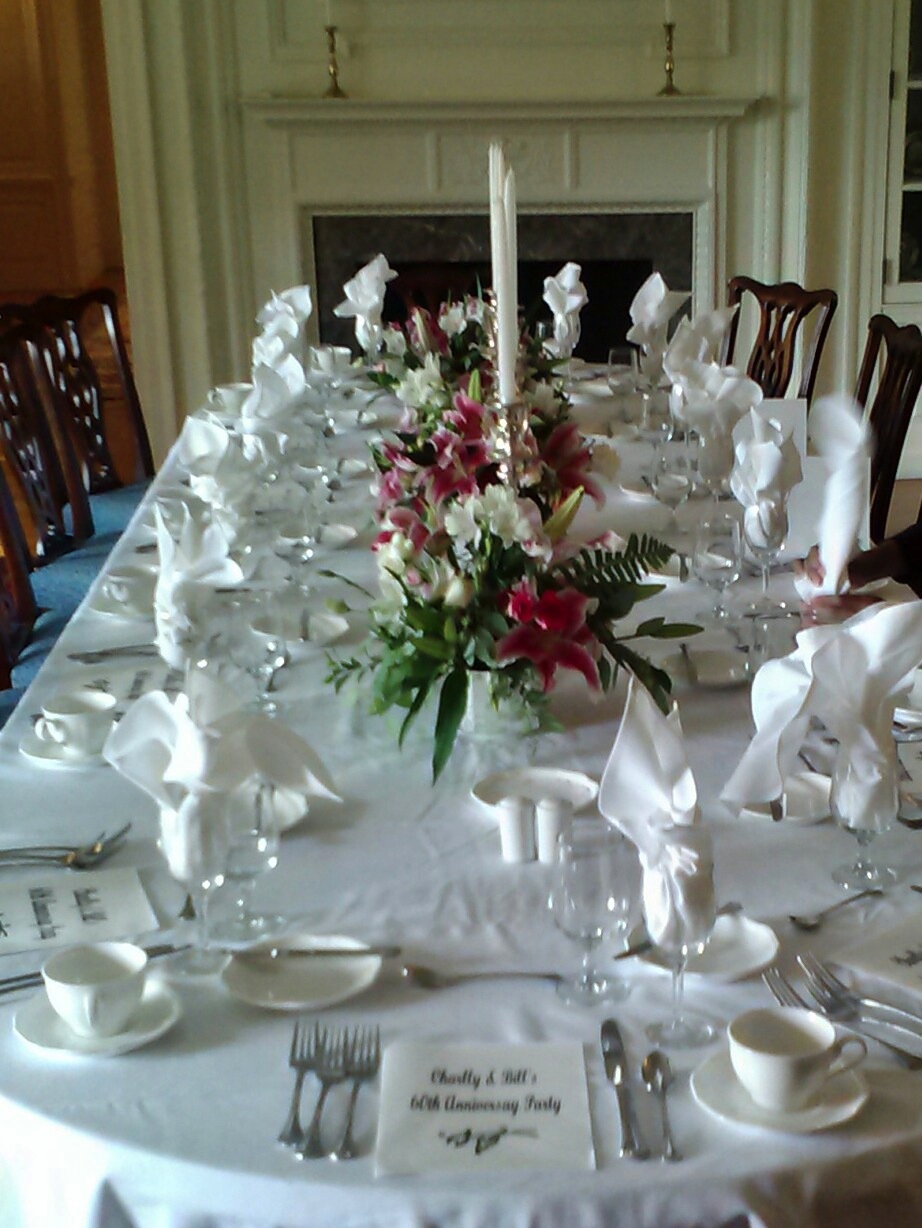
tableAnniversary

arrangements crawling with ants

life is everywhere

This is a zen haiku–because of the ants and the poem’s perception of them. (I use the popular, rather than the faithful, sense of the word “zen.”)

The syllables of the first line fit nicely.  In addition, as in the previous haiku, the first line runs on to the second.  The first line’s label stands alone, as an announcement of the event.  At the same time, it marries the next word in the next line.  This marriage signifies the flower arrangements seen in the attached photo.  Our mother arranged these flowers, as she has been doing professionally and personally for many years.  She loves finding the colors, shapes and sizes that fit the occasion and the table.  Some of my enjoyment in arranging words surely comes from her artistry.  As we tried out these several arrangements  the morning of the dinner, little black ants began emerging from the vases.  We tried brushing them away, squashing an occasional one, but they kept coming, kept crawling out of the ferns and flowers.  We decided to set the vases aside until evening, so that the insects could get their exercise somewhere other than on the dinner table.  As it happens, our plan worked.  The dinner was ant-free, as far as we could see.  The  image, though, stayed with me and crawled into line two of this haiku.  Yes, the ants appeared to spoil the table that morning, but this is my favorite line of the poem.  The phrase “crawling with ants” we hear often, and it fits here because it describes what we saw.  At the same time, the whole line captures the larger idea of arranging or planning anything, only to be disturbed by an unexpected presence.  The word “crawling” does not exactly match the number of little black feet parading across the table cloth–we saw an ant here and there–but it captures the oh-no feeling we had.

The last line, I used to think,  is my least favorite because it seems vacuous.  What does it mean, if anything?  The line actually grew from my wife’s suggestion that we move the vases aside that morning.  Her idea reflects the poem’s zen element.  If the arrangement is causing problems where it sits now, move it over and give it time.   To quote a favorite statement of hers, “If something is not working, change it.”  The ants, as the only concrete image, anchor the poem.  Flanked by an abstract label and an empty statement, their line moves the poem forward.  (Outside the poem, my wife’s suggestion brought a sensible, productive pause into the morning by recognizing the ants’ energy and moving it to another spot.)  This last, seemingly meaningless, line, though, invites an appreciation for all life, even the challenging parts.  This invitation suits the occasion of a marriage that has lasted sixty years.

Leave a comment

Filed under art, challenge, creative solutions, order

home-grown haiku 1

For my parents’ sixtieth wedding anniversary, I wrote several haiku to honor the event.  Since several of them need  explanation, which I gave during the anniversary dinner, I  offer that background here–for people who could not attend the dinner, for myself as writer, and for anyone else looking in.  While these posts repeat some of my impromptu comments, they also include thoughts surfacing since the dinner.

In the order of original composition (15 June 2013), here’s the first one:

Two together still

              Moving furniture pieces

                             To where they belong

Many who know me also know that my parents recently moved after having lived in the same house for fifty years, the house in which I grew up from age nine through high school.  Changing homes after that much time is hard, in several ways.  For example, it tests the relationship between those who are making the change.  This test is reflected in the first line.  The word “still” carries the idea of sixty years, which includes the recent struggle of picking up, packing up and re-locating.  The same word also means calm, as in “Before the sun rose that morning, the lake was as still as glass.”  Placing the word “still” at the end of the  haiku’s line reveals this second meaning more effectively than would, for example,  “Two still together.”

Although part of a haiku’s challenge is to create a total poem while allowing each line to read independently, as a kind of mini-poem,  I enjoy the run-on (spill-over) effect of “still / moving furniture,” which is what my parents were doing on the day of the anniversary dinner.  So, the stillness suggested in the first line contrasts in several ways with the lifting, carrying, placing, transporting and other move-related activities.

The third line, then, echoes the initial suggestion of stillness by claiming that things are as they should be, are where they belong, need no more moving.  The move that looked daunting several years ago has put in place not only furniture pieces, but also the realization that change is often both hard and rewarding.  Such realizations come more readily, when we can share the struggles and rewards with someone we love.

2 Comments

Filed under challenge, creative solutions, discovery, order

haiku meditation: vowel-consonant collaboration

http://farm3.staticflickr.com/2120/1883564903_1a7fb38115_z.jpg

Tumbling upstream

against the racing current–

a white downy seed.

–J. W. Hackett, Haiku Poetry: Volume Two

My favorite line is the first because of the “u” sound and its collaboration with the “mb” in “tumbling” and “p” in “upstream.”  These combinations repeat the darker gurgling sounds of creek currents–that sound that occasionally bubbles up from underneath, bringing to the surface nutrients that lie below.

Line two continues the mystery of what can “tumble” against such a current, in part because I imagine tumbling as a grounded movement involving traction, or a movement of powerful muscles like those of the salmon.

Line three belies the idea of traction because the unseen wind is sending the seed upstream.  The seed is tumbling against, but the “against” is nominal and abstract.  Yes, this dandelion seed is traveling in the opposite direction, but not  with any traction per se.  It skips, like the slender stone I used to throw across the stream behind my grandparents’ house.

Also, in this third and last line the impact of the “u” sound returns.  Whereas the grounded tumbling starts the poem, a whispy white featheriness ends it. The “wh” combines with a long “i,” and the “w” in “downy” repeats this slight consonant.  Like “i” in “white,” the long “e” in “seed” gives this line a higher, airier feel; it sings soprano to the first line’s base notes.  It lifts the poem out of its initial mystery, sending the seed to land who knows where.

Yes, the current of water is “racing,” yet the slight seed moves against it even so.


photo credit: http://farm3.staticflickr.com/2120/1883564903_1a7fb38115_z.jpg


Leave a comment

Filed under art, beauty, challenge, creative solutions

choosing haiku verbs

http://images.google.com/search?site=&tbm=isch&source=hp&biw=1066&bih=544&q=creeks+and+sun&oq=creeks+and+sun&gs_l=img.3...1539.8368.0.9115.14.14.0.0.0.0.114.987.11j2.13.0...0.0...1ac.1.16.img.ZlZgOOCshPk#facrc=_&imgrc=-YFmrmYIrM9U6M%3A%3BxxLJTrJc-SREJM%3Bhttp%253A%252F%252Ffarm5.static.flickr.com%252F4124%252F5061612905_50bc56dd0e.jpg%3Bhttp%253A%252F%252Famericanadventurist.com%252FForum%252Fshowthread.php%253F89-ARSES-Tionesta-Creek-Float-Cancelled-due-to-Weather%3B375%3B500

Sun plays on the stream

and reflects on every tree

its shimmering dance.

–J. W. Hackett (Haiku Poetry: Volume Two, Japan Publications, 1968)

I want to help students choose valuable verbs, and I see guided practice with haiku as a way to aid them–a fun way to challenge young writers in this poetic microclimate, where choice especially matters  because of the tight-fitting form.

For example, I see the first verb in Hackett’s haiku.  What else might work in place of “play,” I can ask students.  What does this verb give us, by way of description and potential?  What does it mean, and how can we build on it, with it?

A note on adjectives: when recording this haiku from (imperfect) memory, I wrote “brilliant” in the last line.  This mistake shows me the value of “shimmering” because it includes the movement implied in “play,” as well as the brilliant reflections.

Therefore, as students, including myself, sharpen a verb, they build a skill that transfers across parts of speech.  In turn, they can more clearly see connections among elements of their descriptions.  They open themselves and readers to ever-more-shimmering sentences.


photo credit: http://farm5.static.flickr.com/4124/5061612905_50bc56dd0e.jpg


Leave a comment

Filed under art, beauty, challenge

Is this cheating?

IS THIS CHEATING?

Students are returning from vacation, and I have imagined a “real-world” writing assignment.  Although this outline represents my draft thoughts, I am leaning towards using it as a welcome-back exercise–in an attempt to  have the departing seniors (a) write with meaningful purpose and (b) play a significant role in designing our experimental “biography unit.”  Is it cheating to have them spend time writing such an essay?  I don’t think so, but thought it would be fun to ask colleagues and other readers.

Incidentally–don’t tell the students–the “list” they will pick up comes from Tony Wagner’s recent writings.  I won’t name which ones, in case some students are closely following this personal blog.  (A number of them subscribe to our course blog.)

bllbrwn423's avatarENG 12H

DRAFT LESSON PLAN reflection

List seven basic skills you will take away from your high school experience.

Pick up list of seven skills identified by recent book on the issue.

Reflect on similarities and differences between these two lists.  For example, what do these patterns mean about your past and future formal schooling?

Use these reflections to write an essay that follows this format:

intro to main idea

most exercised skill in this class

least exercised skill in this class

implications for design of upcoming “biography unit”

concluding thought, which offers insight gained from preceding analysis

(due to TURNITIN by end of this week’s block class; include amended pledge, which acknowledges, for example, conversations with classmates)

View original post

Leave a comment

Filed under challenge, creative solutions, discovery, reasons for writing

Do we really need poetry?

In several of today’s classes–two sophomore and one senior–we listened to the NPR piece about John Borling’s book of poems, Taps on the Walls.  Having heard this interview during my drive to work this morning, I wanted to share it with students, and hence with readers of this blog.  It is a remarkable answer to a question I have asked my poetry classes in the past:  do we really need poetry.

After students listened to the program, which I recommend you do (7’48” long), we literally tried our hands at composing with the code used by Major General Borling and his prison mates.  Since the sophomores are just finishing The Kite Runner, I asked them to start a poem in the voice of Amir–a poem expressing what Sohrab means to him.  Then they were to try tapping the first line of this poem for their neighbor, as one concrete way to appreciate the importance of poetry for Mr. Borling during his six and a half years of brutal captivity. You can catch a glimpse of their handiwork on the youtube video above. I hope this mini-lesson opens for them a small window on the remarkable human spirit and its need for artistic expression.

p.s. Apologies for the extra youtube videos; I am trying to learn how to post just the one video I made, without these extraneous, unendorsed connections.

2 Comments

Filed under art, challenge, creative solutions, expression, reasons for writing

Hamlet’s facets, posing questions

The seniors recently wrote about Hamlet, at the end of Act Two.   My wife remarked that the instructions modeled my thinking to these students, so I decided to share those instructions here.  The text of their assignment below reminds me of work with Project Zero and the idea of “making thinking visible.”  (In this case, my thinking becomes visible.) I have pasted the students’ instructions underneath this sentence; afterwards, I reflect on this approach to generating a question.

ASSIGNMENT

Hamlet Writing, after Act 2

Choose three separate lines or brief sets of lines from Hamlet’s soliloquy (2.2.501-558) that support your answer to the question below*.  Following the “11-sentence” model, use these chosen quotations in your paragraph.

Hamlet mixes feelings of superiority—for example, through his confidence in manipulating people’s perceptions of him—with an apparently uncontrollable emotional side that is overwhelmed with grief.  In sum, he feels above everyone else and overwhelmed—that is, in control and out of control.

*What light does his soliloquy shed on the tension between these two sides of Hamlet’s character?

(State your main idea with some version of this basic structure: “the speech reveals that . . . .”)

Summary of sample student interests in Hamlet’s character

Depressed

Determined, willful; passionate; extreme; takes risks

Sense of duty; loyalty

Manipulates people while remaining seemingly unengaged; gets what he wants     without appearing overtly forceful; his ability to pretend

Grief as the driving force

Intelligent; good at reading people; tricky, clever

Emotion takes over his whole being; distinctive intensity; emotionally genuine

“plays off” two completely different personalities—disingenuous and genuine

switches diction from obscure riddles to elegant poetry

mischievous side—funny, entertaining

strange logic in pretending madness while mocking others for insincerity

mistrusts others, even in family; skeptical, resistant

complex characteristics, mysterious, unpredictable

his sense of entitlement and cockiness; shows others his power

REFLECTIONS (and brief explanations)

 As we were nearing the end of Act Two,  I asked students to write on an index card the facet of Hamlet’s character that most interests them and to explain why it draws them in.  While they read the “O what a rogue and peasant slave” speech for homework, I summarized their interests.  That summary is the italicized list you see above.  I considered the patterns emerging from their varied interests. You see these considerations immediately above the question.  As these patterns developed, the question started to take shape–more from the combination of their interests, than from my preconceived responses to the play and its main character.   I did not know what would come from examining their interests, but I was excited to find out.  By transcribing, combining and studying their ideas, I started to see a tension that I could phrase in terms they would recognize.  (I explained this process to them in class before they started writing, so that they would know how to read this instruction sheet.)  We will see how their writing turns out, but I feel this process of creating a question from their genuine affinities has promise.

In addition, the list of student interests shows them–all of us, for that matter–how rich a character Shakespeare has created.  With no prompting from me, the students have demonstrated Hamlet’s complexity.  I told them we were using the term “facet,” instead of the plainer word “aspect,” because it adds the idea of a gem stone.  Hamlet is a gem, and so are they.  We all have many sides to us, and I am excited to see how each of the students addresses the tension they have collectively identified in Hamlet.

 This kind of excitement is one of a teacher’s simple pleasures.  Simple, yes, but at the same time a deep pleasure because the exercise is growing from authentic student interest.  These features of Hamlet resonate with them for various personal reasons.  Those connections alone help me help them.

Leave a comment

Filed under challenge, reasons for writing

two simple stories: Glock and Bach

Without judgment, I offer two personal stories from this past week.  They occurred within a day of each other.

First story: At lunch–during a discussion of guns, death and violence–a colleague described his neighbor’s reaction to the death of Sandy Hook students and teachers, as well as to the possibility of additional regulation of guns and ammunition.  According to the colleague’s reasonable, and in my judgment sympathetic, report, his neighbor already owned an AR-15, and since the Sandy Hook deaths has purchased several more.  When asked why he had purchased these additional guns, the neighbor responded that he wanted to be ready when they, the government, came to his house.

Second story: At our high school’s weekly chapel service, two senior boys played a concert to benefit the Youth and Family Services of Newtown, Connecticut.  The seniors themselves requested the opportunity, chose the music and provided the commentary between pieces.  During their performance, which they entitled “Reflection and Outreach,” they explained that it can be hard to find words at such times, and that music can express emotions in these situations.  When I asked one of the boys about why they asked to do this concert, he said that the feelings expressed in the music could serve as one way to empathize with the Sandy Hook community.

To me, these two stories represent significantly different ways of seeing the present and future worlds.  I am also reminded of the two essential questions that guide my work with high school sophomore classes:  Who am I?  What are my primary responsibilities to myself and to the communities in which I live?  Most of our reading and writing focus on a student’s, character’s or author’s answer to these two questions.  I wonder how the neighbor and senior boys would answer these questions.  And I wonder what those answers mean for us–today and tomorrow?  Finally, I wonder how my responses to the colleague and the students defines my answer to these essential questions.

7 Comments

Filed under art, beauty, challenge, creative solutions, empathy, expression, trust

The Art of Translation

The Art of Translation.

I wanted to share this recent reflection by a girl in one of my high school senior classes.

She typically writes with such clarity and depth.

Leave a comment

Filed under art, beauty, challenge, discovery, imagination, reasons for writing

flip the flippers

One day this week, as the sophomores started reviewing each other’s blog posts, I spoke briefly to the whole group about pedagogy.  Though not using that actual word, I raised this question:  Why bother gathering at a physical place called school?  The question allowed me to share my thoughts on the subject–thoughts that have been developing over the years spent with students in a physical place called the classroom.  As I described my thinking to these sophomores,  I asked them if they had heard teachers mention the idea of a “flipped classroom.”  No one raised his or her hand, but soon after the silent response, one boy offered, “Do you mean students teaching teachers?”  I told him, and therefore the whole group, that although I do not remember adults using those terms , I thought his idea was fabulous.  “I want to remember your idea,” I told him.  “Some time,” I added, “I can tell you stories about students doing exactly that.”  For example, I remember a ninth grader in Tulsa who unwittingly helped me tighten my writing.

So, back to what I was telling the whole class, before this teenager “interrupted.”  I was answering my rhetorical question, using the example of their in-class partner-proofreading.  The most productive use we can make of in-school class-time–I am paraphrasing now– is for real-time social interaction–in the form of meaningful collaboration, for instance.  Let students work together to help each other.  Let them, for example, with our guidance, give each other feedback on their writing.  The adult guidance is key, and we can layer samples, models, practices and demonstrations to develop the basic skills that enable productive feedback.  But, as the adult conversations about flipping continue, I want to include the students–from time to time, not all the time.  Occasionally, I find myself forgetting to extend the hand of respect to the students.  I forget to offer that hand and bring them onto the boat.  Sometimes, in my excitement to cross the river, I find myself on the other side, waving encouragement to the students who stand on the far shore.  “Swim,” I yell.  “Swim.”

The trust and respect that underlie healthy relationships must characterize my time with students, too.   They are intelligent young people with distinct, valuable thoughts.  Why not use all of our human resources, once we have come together in the same physical place called school?

Leave a comment

Filed under challenge, creative solutions, discovery, trust