Category Archives: discovery

signifying nothing 5.5.23

This week, the seniors and I have been working on the difference between a poem’s speaker and author.  The following sequence of ideas arose this morning, while my wife and I drank coffee and talked on the deck,  and while the sunlight  touched the tops of our neighbor’s seventy-foot pine trees.

We saw his pine trees, as well as what used to be an equally tall oak, until a July storm dropped its top half.  During this morning’s coffee talk, I recalled that our neighbor, let’s call him Paul Bunyan, finally began cutting the fallen limbs with his chain saw last night.  Mention of the chain saw reminded me of Frost’s poem, “Out, Out,” which the seniors had recently read.  In fact, some seniors may be using that poem for their first essay about tone; I hope I steal none of their thunder with this post.  (Ssshh, don’t tell any  of them about this post, yet.)

Naturally, at least for us two career literature teachers, Shakespeare entered the conversation–in the form of Macbeth, whose speech after Lady Macbeth’s death includes the phrase “Out, out, [brief candle].”  When I repeated Frost’s title, my wife gave Macbeth’s next thought, “Life’s but a walking shadow” (5.5.23).  At this point, my mind returned to this week’s work with seniors; I often find my mind going there.

Here, I thought, is a fine example of the energy created by the difference between speaker and author.  My first thought on remembering Macbeth’s speech was that I disagree with his final claim that life is a “tale / Told by an idiot, full of sound and fury / Signifying nothing”–especially as I sat with my wife during this morning’s sunrise.  Then I realized, perhaps in a freshly rich way, that so does Shakespeare.  If he agrees with Macbeth, why bother writing all of these plays?  At this point in the Scottish play, Macbeth has reached the very bottom of his despair and hopelessness.   Ever since he has told himself that he is in bloody murders too steeped to turn back, he has been pursuing an untenable human course.  He has separated himself from his most worthy being, as well as from other people.  His moral coherence, his ethical integrity has been dissolving, unlike the blood on Lady Macbeth’s hands, which she cannot remove with her bootless cry, “Out, out, damned spot.”

Shakespeare, the author of Macbeth’s final desperate words, does see human life as signifying something, even while imagining a character who does not.  In fact, through his art, the author tries to lead us away from such despair by enacting the journey that led to it.  He wants to bring the lesson alive on stage.

And here, at this junction of  speaker and author, I am reminded of a critical thinking skill that appeared on my recent blog post’s list of such skills.  In this case, I am thinking of “shape meaningful schema.”  Students who understand the play’s plot, Macbeth’s decline and the speech’s words are ready to combine these understandings with the author/speaker distinction, in order to shape in their minds a pattern that makes sense, that means something, that signifies something.  With all due respect to Mr. Macbeth, I will keep making meaning–even out of his story.  I will keep helping students do the same.
Leave a comment

Filed under art, challenge, creative solutions, discovery, empathy, imagination, order, reasons for writing

a borrower and a lender

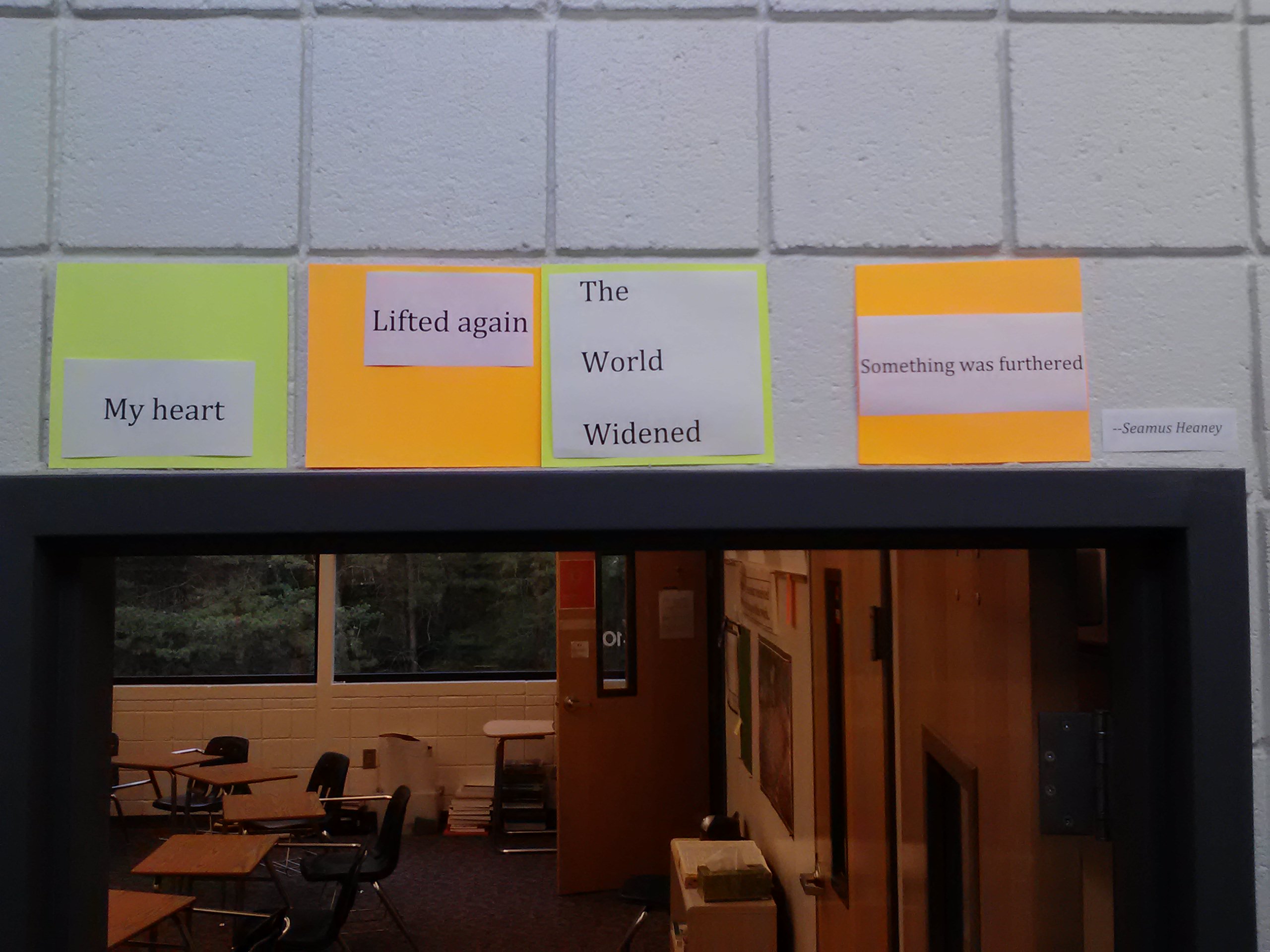
I thought readers of this blog might enjoy a recent assignment described for my seniors.  They have started writing reflections on poems they find in our text, and I gave this guidance for their first piece; these instructions grow from a sentence in Seamus Heaney’s introduction to his Whitbread-Award winning translation of Beowulf.  Enjoy.

For this first reflection, base your writing on a single poem from chapter one of Mr. Kennedy and Mr. Gioia’s Introduction to Poetry.  In the previous assignment for this week, I asked you to pick a poem on which you would like to reflect.  As you consider this poem, use the quote from Seamus Heaney, seen in the photograph above.  His brief statement comes the introduction to his translation of the Old English narrative poem, Beowulf, which we will start reading in several weeks.  I posted his passage in a prominent place because I admire and value the thought and feeling behind it.  In his introduction, he describes a particular struggle he experienced during the translation project.  He struggled to reconcile apparently disparate parts of his past.  His perseverance eventually led to a discovery that produced the statement above our door: “my heart lifted again, the world widened, something was furthered” (xxvi).  I would like to use this statement as guidance for your first reflection.

In other words, use any or all of the statement’s parts as guides for writing a reflection of approximately 200-400 words; this will be the typical length for reflections posted on your blog.  Let me explain my thinking about how to use the parts to Heaney’s statement.  “My heart lifted”: Consider a poem that lifts your heart in a small or large way.  Perhaps the poem as a whole does this, or maybe a single line.  You can read “lifted” loosely.  In other words, something about the poem satisfied you, or rang true, resonated, or made you say “yes” in some fashion.  It made you feel fuller.  “The World Widened”: As a result of your heart’s lifting, your understanding of the world, which includes yourself and other people, has widened.  To borrow from Rilke, another poet, your orbit has grown wider.  You see more because of this poem or this line.  “Something was furthered”: This sounds like the previous part of the statement, but it also suggests that the world evolved in some way because your world widened.  Some problem was solved, some insight gained.  Some larger value was added to the world because of this thinking or feeling you are doing.  Admittedly, this last part is probably the hardest to apply, but feel free to give it a go, if you are so inclined.

As you write your reflection, use my explanation of Heaney’s passage as guidance–rather than as a set of questions all of which you must answer.  The fun and beauty of such reflective writings is that they give you a chance to notice and follow your responses.  Let the associations happen, while challenging yourself to be as clear as possible–to yourself and your blog readers.

Have fun.  Enjoy the writing.

Leave a comment

Filed under beauty, challenge, creative solutions, discovery, joy, reasons for writing

I wanna care

Before I entered junior high school, my parents sent me to reading camp.  I do not know all of the diagnostic details explained to my parents, but I do remember regularly struggling to read “fast.”  Years after junior and senior high, I find myself telling others, including my high school students, that I struggled to read fast enough to care about the fictional characters I encountered.  Why read, if you cannot care about the people involved?  That became the underlying dynamic of my high school reading–in literature, history and elsewhere.

This remembrance of things past surfaces today, while reading reviews of Gita Mehta’s novel, Raj.  A friend just told me he is considering one of her other novels, A River Sutra, for his Humanities class’s India unit.  While reading about this novel and her other books, I encountered the following excerpt:

Princess Jaya of Balmer, witness to bloodshed and insurmountable political upheaval, realizes that royal India’s demise is imminent. “Although the rich background detail is engrossing, Jaya remains a remote character to whom one never develops an attachment,” PW [Publishers Weekly] said of this novel penned by the wife of Knopf’s Sonny Mehta. Author tour.  (from Amazon.com, emphasis added)

Without having read her books, I cannot agree or disagree with this or any review, but the quoted sentence sparks a memory of my early reading experiences.  The maroonballoon blog has become, especially this summer, a place to remember and recount the dynamics of my own reading and writing.  Time–in the close sense of summer vacation, as well as the broader sense of my career–invites me to reflect on the basic dynamics and associations within my own composing and comprehending.  Awareness of these personal phenomena equips me more robustly, as another colleague might put it, to understand and guide students’ reading and writing.  A heightened awareness allows me to communicate more convincingly, “I’ve been there.”  It also enables me to spot their struggles and deconstruct the confusion they might be experiencing.

Now, as an older person, I enjoy reading and writing, though still struggling to read “faster.”  I look forward, for example, to reading A River Sutra.  I also will be reading Chief Justice Roberts’ majority opinion in the recent Affordable Health Care Act decision.  I just enjoy reading stuff–of various sorts.

Reading a variety is important for students; they need to be flexible readers.  This wide exposure strengthens–i.e., makes more robust–their writing.  In my case, for example, reading the first pages of Justice Roberts’ opinion helped me write my letter of protest to the GA Dept of Revenue.  Writers write their reading.  Seeing Roberts’ careful wording and conceptual coherence inspires me to greater precision.  So it is with students younger than I .

Today’s title, by the way, is meant to echo the label some people use to identify the law officially passed as the Patient Protection and Affordable Care Act of 2010 (Public Law 111-148).  I know this blog post title captures a primary principle in my reading experiences, and I believe it reflects the best instincts of most people, as they consider the long-term health of all Americans.

Leave a comment

Filed under challenge, discovery, empathy, expression, joy, reasons for writing

pattern recognition

I find myself repeating myself.

As I wrote yesterday’s post, I found myself repeating myself.  In other words, ideas or phrases kept re-emerging, floating to the surface of my attention.  For example, the gaps I mean–to echo Robert Frost’s poem, “Mending Wall.”  The idea of gaps cycled back through my attention, and I enjoyed its return because that gave me momentum.  The momentum was fueled by the fun surprise of the re-emergence; I did not plan so much as discover it.  A bit like turning over soil and discovering worms wriggling about.  Once the idea of gaps returned for the first time, I began seeing it as a recurring theme that I could intentionally nurture.  A structure of sorts emerged, or a motif.  I could then identify and develop different kinds of gaps.  Sometimes I impose structures beforehand, but at times like this, the frameworks emerge more organically.  In these vacation reflections, I can play around with this organic material.

So what about pattern recognition?  This is a specific skill within the broader ability called problem-solving.  Teachers need to help students develop this specific skill, and literature study provides a tool for this training.  So does reflective writing.  One benefit of my playing around with this organic material–there I go repeating myself–is that I can practice pattern-recognition.  In this particular case, I have seen a concept repeated.  The start of a pattern happened unintentionally, for the most part; I then continued the pattern on purpose.

link to previous post

Students benefit from being able to “listen” to the sequence of their own ideas.  Reflective writing can provide practice at “hearing” recurring concepts in their mind.  Those patterns, I have found, serve as productive launching pads for their individual writing.  Their voices are more likely to emerge in writing that builds from patterns in their own minds.

final comments

I enjoyed seeing the idea of gaps recur.  This recognition had the ring of revelation.  Maybe not to the scale of Joyce’s epiphany, but it had a spark of joyful learning nonetheless, and that’s my main reason for sharing it.  Many writers no doubt have already firmly learned this feeling of pattern recognition emerging from their composing, but–to paraphrase Neruda’s “Ars Poetica I”– I am learning this by working with my own hands, which is the kind of learning I hope for students.

Yesterday, I hung some dill branches in the shed to dry.  Later, we can use the dried seeds to flavor dinner dishes or to plant new seedlings.  In either case, the dill work reminds me of an idea for my youtube series, growing writers.  That series explores connections between gardening and writing.  In the case of dill and yesterday’s post, I have harvested the idea of gaps  for future use.  Since the seeds are drying, I can use them any time I want–to flavor a meal or grow more plants.

Leave a comment

Filed under challenge, creative solutions, discovery, expression, joy, reasons for writing