Category Archives: creative solutions

high stakes reflecting: screw your courage to the sticking place

wichita

summary of recent events with high school seniors:

After a month of studying Beowulf, seniors wrote and re-wrote individual essays, based on ideas they themselves generated.  They spent about a week identifying, developing and refining those ideas in their essays.  They revised their writings with classmates’ feedback, and with mine.  Not until then did they submit the essay for formal assessment–i.e., grades.  Given the time spent, these grades were entered in the most weighted category of “Major Grade.”

Shortly thereafter they completed a written response to four questions (see below*).  I call this exercise a “Regular Reflection,” and students write one after each unit.  This is the third time they have done so since we started school in early August.  And here is the “high stakes” idea reflected in this post’s title.  Though most students completed the reflection in the one class period (50′) made available, they all had submitted this writing by the end of the day, as expected.  So, time spent on this exercise equalled less than 20% of that devoted to the revised essay.  The score for this Regular Reflection, however, carried the same weight as the essay.  It, too, went in the “Major Grade” category.

It feels risky to place both assignments in this category, which means high stakes for me as an educator.  The students have less time to produce quality work, without feedback from anyone else, which translates into high stakes for them, also.

Why do this?  To represent the high value I place on reflective writing and learning.  The student excerpts below** suggest this pedagogical risk is worth taking.  These writings offer me and the students valuable insights.  I wonder if we could imagine a standardized way to implement high stakes testing like this.  Can we scale up such instruments?
long mtn pond

*Regular Reflection questions

Subject/Activity: Beowulf & Old English Poetry

Associations (linking new information to existing knowledge)

What did you already know about this subject? What have you learned from our activities? Explain the connection between your previous knowledge and your new understanding.

Patterns (making patterns from these associations)

In considering your new understanding alongside everything we have studied so far this year, what patterns do you see?

Emotions (feelings about the new experience/information)

How do you feel about what we have been studying or doing? Please develop (explain) your response beyond a single statement.

Meaning (establishing personal meaning)

What personal relevance do our studies have for you? Or what personal relevance might they have? If none, please explain that response.

An enriched environment comes from matching teaching practice to nature of how the brain learns. It learns in six ways:

  1. By associating—e.g., in sensory cortex; it links new information to existing knowledge; it uses power of personal associations (cf. difference between learning as information and as transformation)
  2. By shaping associations into patterns (sometimes forcing patterns that do not exist?)
  3. Runs on emotions—limbic system works as a relevance detector
  4. Mostly beneath the level of awareness
  5. Learns through the body
  6. Makes meaning

(personal notes from “Teaching to the Teenage Brain” conference leader, Gessner Geyer, 25 July 2005)

tumblr_m31sbqdWfu1qkt9aoo1_500_large

**student excerpts

“We have been exposed to unique forms of poetry that I had never encountered before. I have learned to enjoy English class because this is definitely not your average class. We expand upon our thoughts much more than I ever have in any other class, and we explore meanings and learn to understand characters. We also learn why the form of poetry we are studying at the time is written the way it is, and learn to write that way ourselves. As far as Beowulf, I feel knowledgeable now about a story I would have never picked up before. I learned to enjoy the poem . . .  I feel much more confident about my understanding of poetry now that I have learned how to dissect poems.” [emphasis added]

” Preliminarily doubtful that I would enjoy Beowulf because of its old age, I astonished myself when I started to become interested in the storyline and characters. Confused when I felt sorry for a demon, I began to almost feel sympathetic for the monsters, especially Grendel’s Mother who suffered great grief after the loss of her son.”

“I see a pattern of exposure to something we may not know much about at all, and then after a brief exposure, explanation of the subject material. We are allowed to explore the material a little on our own and attempt to draw some of our own conclusions before we are taught the material. I like this tactic a lot as it give[s] us students the chance to tackle new material on our own before receiving assistance. This can translate pretty well to the post-school world as we will not always have a teacher their [sic] to help us right away, and we may have to attempt to draw conclusions ourselves.” . . .

“Beginning to reflect on this section of studies, I realize that the impact it may have on me will not be as much related to the content as to how I went about interpreting the content. The paper helped me to look at things I read or study differently. When prompted with a vague [sic] question, you do not respond with a vague response. The point of the ambiguity is to allow you to interpret the question the way you want. It is open ended to allow you to pick a specific point that you are passionate about instead of forcing you to write something you don’t care about. The paper will help me in the future to look at writing prompts a little differently.”

ed park.07nov14

For me, the issue of trust lies at the heart of these conversations.  High school students, especially seniors, are thirsty for trust.  They want to trust adults in the community, and equally importantly, they want to be trusted.  Placing high value on their reflections shows genuine trust.  Why not find ways to do this?  I was powerfully reminded of this lesson, when I read about a former student who, as a high school senior, asked me to direct the original play he wrote that year.  I trusted his talent, responsibility and commitment to creative expression.  You just never know, but if you screw your courage to the sticking place . . . .


Leave a comment

Filed under challenge, creative solutions, discovery, trust

Modern Monsters

Seniors have just begun their own blogs. If this model post is any indication, wonderful insights await the readers of these student reflections.

kyliethurber's avatarRiddikulus

tumblr_m31sbqdWfu1qkt9aoo1_500_large

In Seamus Heaney’s translation of Beowulf, the protagonist faces demons and dragons that threaten the lives of those around him as well as his own life. The author eagerly describes the heroic battles in which Beowulf conquers medieval beasts with dangerous weapons. With each monster more difficult to defeat than the last, Beowulf continues to vanquish his enemies and protect the kingdom of the Danes. Heroic even in his last moments, Beowulf embodies courage as he embarks on his journey to defeat the terrifying monsters jeopardizing the kingdom’s well being as a whole. Praise and glory accompanied Beowulf in defeating his monsters, but what about those whose monsters cannot be conquered with a sword or any material object alone? In Beowulf, the beasts were clearly defined and, in the end, each could be thwarted by means of a weapon. However, in reality, our own modern monsters hide in secluded…

View original post 216 more words

Leave a comment

Filed under creative solutions

Learners Should Be Developing Their Own Essential Questions

Jackie Gerstein, Ed.D.'s avatarUser Generated Education

2013-03-24_0800

Having essential questions drive curriculum and learning has become core to many educators’ instructional practices.  Grant Wiggins, in his work on Understanding By Design, describes an essential question as:

A meaning of “essential” involves important questions that recur throughout one’s life. Such questions are broad in scope and timeless by nature. They are perpetually arguable – What is justice?  Is art a matter of taste or principles? How far should we tamper with our own biology and chemistry?  Is science compatible with religion? Is an author’s view privileged in determining the meaning of a text? We may arrive at or be helped to grasp understandings for these questions, but we soon learn that answers to them are invariably provisional. In other words, we are liable to change our minds in response to reflection and experience concerning such questions as we go through life, and that such changes of mind are…

View original post 1,452 more words

Leave a comment

Filed under creative solutions

On Being a Student: exposure + reflection = learning

As I have written previously in this series, my recent NEH experience differs significantly from that of my students during the “academic year.”  I applied and was accepted for two weeks of focused study.  I chose the subject, and I  devoted eight hours a day to this pursuit, not counting the preparatory reading before the course began.

By contrast, “my” students attend class for fifty minutes, except for the one eighty-minute block per week.  For most of the students, this class is one of seven they encounter in a day.

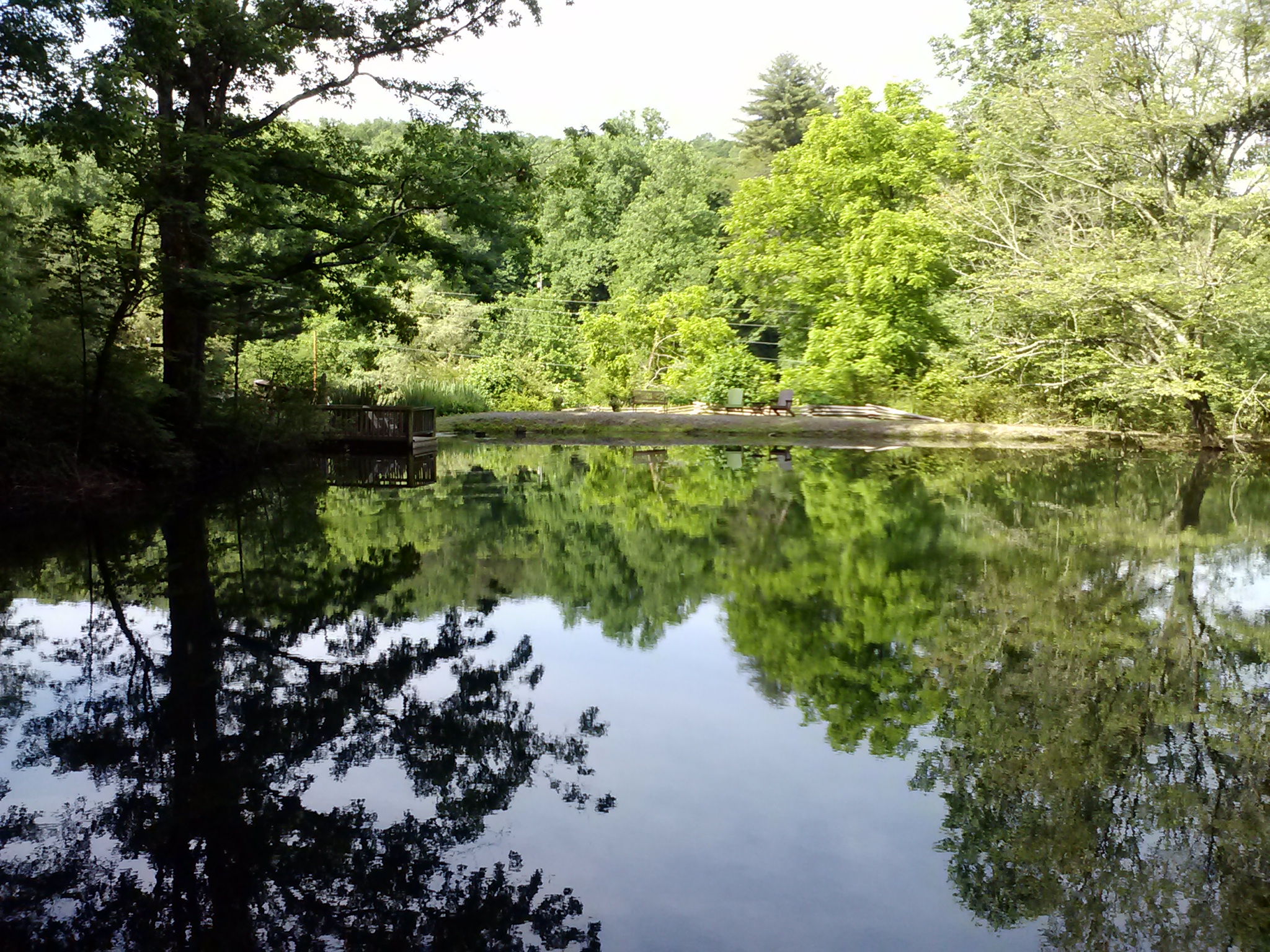
During my two weeks this summer, the leaders provided a wide array of material.  We were exposed to a rich range of primary and secondary sources, covering classical and modern poetry from as far west as Sierra Leone and Cordova and as far east as Bangladesh and Uzbekistan.  Because we read, heard and discussed so much, I feel the need to review and reflect on our handouts and my notes.  Without this process of reflection, much of what ran across my ears, eyes and mind will flow over the dam–like the water in the attached photograph from the north Georgia mountains.

This same photograph depicts the beauty of reflection.  Students, which includes me and those high schoolers with whom I work, need time to reflect.  What strikes me most about this picture and this process is the stillness.  The clearest reflection occurs when the water looks like glass, when the pond becomes a mirror.  Yes, we can digest valuable material by moving, performing and altering details of the subject matter–and this often works well, but this post focuses on reflection, rather than active re-working.  (One kind of re-working, for example, to which I am particularly partial when studying poetic traditions, is to compose original pieces in the spirit and/or form of those traditions.  In the context of the NEH work, the ghazal tradition comes first to mind.)

Finally, a reflective tool (reflective pool?) I invented several years ago.  Since then, students in my courses have used it to reveal–to themselves and me–the impact of their studies.  Why not use this same tool to reflect on my NEH work this summer?  According to the students’ “short writing rubric,” I will try to write according to these three criteria: clear, specific, developed.

long mtn pond


Regular Reflection Sheet

Subject/Activity:


Name:_________________________________________   Date:


Associations (linking new information to existing knowledge)

What did you already know about this subject? What have you learned from our activities? Explain the connection between your previous knowledge and your new understanding.


Patterns (making patterns from these associations)

In considering your new understanding alongside everything we have studied so far, what patterns do you see?


Emotions (feelings about the new experience/information)

How do you feel about what we have been studying or doing? Please develop (explain) your response beyond a single statement.


Meaning (establishing personal meaning)

What personal relevance do our studies have for you? Or what personal relevance might they have? If none, please explain that response.


An enriched environment comes from matching teaching practice to nature of how the brain learns. It learns in six ways:

  1. By associating—e.g., in sensory cortex; it links new information to existing knowledge; it uses power of personal associations (cf. difference between learning as information and as transformation)
  2. By shaping associations into patterns (sometimes forcing patterns that do not exist?)
  3. Runs on emotions—limbic system works as a relevance detector
  4. Mostly beneath the level of awareness
  5. Learns through the body
  6. Makes meaning


(personal notes from “Teaching to the Teenage Brain” conference leader, Gessner Geyer, 25 July 2005, Sierra Nevada Mtns, CA)


2 Comments

Filed under beauty, challenge, creative solutions, reasons for writing

impressive imperial map

During this month’s NEH Institute in NYC, Dr. Francis Pritchett, a scholar of Urdu poetry, showed us this wonderfully helpful map, which comes from the Maps-of-War site:

Imperial History of the Middle East


Thank you, Dr. Pritchett.

Leave a comment

Filed under creative solutions

History and Homework: Reflections on Independence Day

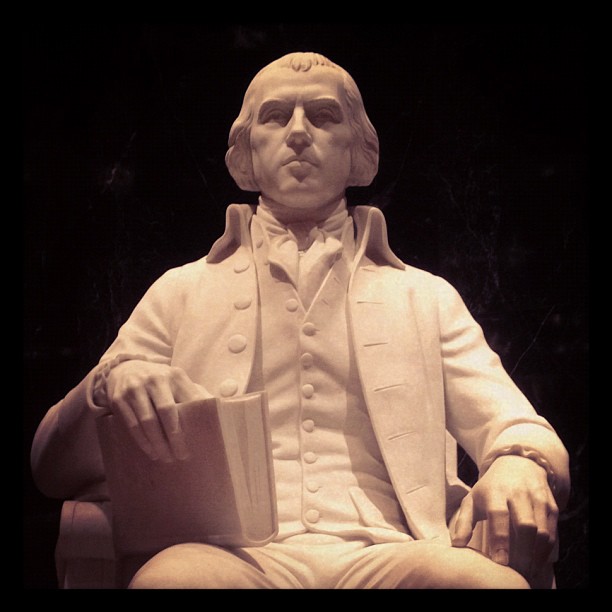
My favorite quotation for this year’s national holiday comes from Michael Waldman’s recent book, The Second Amendment: A Biography.  In the book’s first chapter, Waldman says this about James Madison’s preparation for the Constitutional Convention:

And once it [the Constitutional Convention] had been scheduled, he drove himself to study world political systems, trying to understand how republics rise or fall.  Thomas Jefferson sent him two hundred books from Paris for the cram session.  Even before arriving in Philadelphia [in the summer of 1783], Madison had sketched out a new approach, one with a strong central government and power divided among three branches: legislative, executive and judicial.

madison

Two thoughts prompt me to record this quotation today.

First, amidst pedagogical conversations about the value of homework , I like to consider the term as a metaphor for preparation. Be sure to do your homework, we say.  James Madison clearly did his before the convention.  It also occurs to me that he had strong reasons for doing so.  When we teachers require students to do homework, let’s work hard to make these studies meaningful.  Learning happens most durably with clear purpose that matters to the learner.  As with James Madison, such learning propels people towards independence.

Second, a colleague once articulated to me and I see regular evidence supporting his idea that a strong strain of what he called anti-intellectualism runs through American culture.  I know firsthand about this.  A family friend once reacted to my National Endowment for the Humanities fellowship by expressing disapproval that his hard-earned tax dollars had gone to such ventures.  In the context of his particular response and what it represents more generally, I remember James Madison’s commitment to reading.  Thank heavens for people who have the skills and take the time to study–history, for example–in order to help move this country toward a more perfect union.  Historical examples show me that true patriots understand and support the value of such intellectual pursuits.  Teachers and students should show pride in minds sharpened by reading–both broad and deep reading.


photo credit: 

http://rasica.files.wordpress.com/2013/01/flickr_-_uscapitol_-_president_james_madison_memorial.jpg


3 Comments

Filed under creative solutions

fun with the flipped classroom

Here’s a fun little video on the subject–from a friend and colleague who teaches Science, mostly Physics.


Leave a comment

Filed under creative solutions

examining exam principles

To honor colleagues who have coordinated monthly conversations as part of a Professional Learning Community (PLC), I want to share “Exam Principles” that I recently explained to my students. Tomorrow’s PLC conversation topic is the value of final exams.

Principle #1

Patterns, comparisons, synthesis => new realizations, recognitions, insights

Principle #2

Express realizations, etc, => state clearly, develop convincingly

Principle #3

Handle new problem / challenge / complexity => reasonable, confident solution


A summary of my explanation to students

Since we have read plays and novels more or less in isolation, the exam is a chance to consider titles together.  The exam, therefore, invites you to discern patterns, make comparisons and synthesize ideas.  Through these processes, you create new realizations, recognitions and insights.  The exam is a time to forge new observations and interpretations, rather than repeat old ones you and I already know about.

Equally important, the exam questions your ability to express–in conventional essay form–these new insights.  The two main tasks are to state your idea clearly and to develop it with an array of compelling evidence.

Lastly, and more generally, the exam gives you questions (problems) that you have not yet encountered with this reading material.  It tests your ability to face a complex challenge and develop a reasonable answer.


This time, students will have two separate questions, each to be answered in essay form.  The questions take into account the above principles.

 
greek terraces

1 Comment

Filed under creative solutions

more poem ideas for next Poetry Friday, Apr 11

As students rev up their poetry engines for next week’s poetry contest, I wrote this to feed the soil of their souls. I think that extending “filament, filament, filament” of ideas and models enriches the possibilities of their own creations. Plus, I thought other people besides my students might enjoy these poems.

bllbrwn423's avatarENG10H World Literature

Teacher Reads

Recently I started reading a book called Love Poems from God: Twelve Sacred Voices from the East and West, translated and introduced by Daniel Ladinsky (Penguin, 2002).  The first chapter contains poems by Rabia, an Islamic woman writing in eighth-century Basra.  Some of you may know that Basra lies in present-day Iraq. Her poems remind me of topics I offered you lastFriday as starters for this coming week’s poems.

Hafiz

Before showing you some of Rabia’s poems, I want to give you one by Hafiz, the Persian poet who lived in present-day Iran, five hundred years after Rabia,.  This poem appears in another of Ladinsky’s books, The Gift: Poems by Hafiz, The Great Sufi Master (Penguin, 1999).  I offer it here because it connects to our essential question about behaviors and beliefs that cause strife and grief.  Hafiz’s poem, “The Sad Game,” goes like this:

Blame

Keeps the sad…

View original post 378 more words

Leave a comment

Filed under creative solutions

The Tempest Being Reflected

This student has located Shakespeare’s TEMPEST squarely in a local, contemporary problem, and we have just barely finished the first act.

Leave a comment

Filed under creative solutions