Category Archives: creative solutions

faces, names, voices

Most public high school classes have relatively large numbers of students, which challenges a teacher’s ability to learn names in the opening days.  Independent school classes typically have fewer students.  Even so, I find it hard, at each new year, to match names with faces.

Last year, for example, I had several sets of twins in my classes–identical twins.  In one case, two brothers looked exactly alike–from my untrained, unpracticed, unaccustomed eye.  Literally all year, I tried to master the distinction.  Through this struggle, I eventually discovered that I could tell them apart from their writing–i.e., from their authorial voices.  Though these twin faces frustrated me, I could hear the differences in boys’ sentences.

This year, partly because I have more students than last year–though still only half of what my public school colleagues face–I worry about how quickly I will remember names.  We are forging ahead with writing right away, so that I can get to know the individuals as writers and thinkers.  Eventually the face recognition will happen;  it does every year.  In the meantime, if I think of each of them as hummingbirds, I want to keep quiet and still enough to feel the wind from their wings as they approach.

Leave a comment

Filed under creative solutions

Growing Writers 19 Start anew

Season 2, Episode 4

Leave a comment

August 2, 2013 · 8:20 pm

Beluga Whales, Facebook & Egypt

Beluga_whale

Recently at the Georgia Aquarium in Atlanta, we saw beluga whales–beautiful, graceful, snow-white swimmers.  The wall plaque explains that they use echolocation.  In other words, they see with sound. They send sounds from a focal point in their head–the name for this point I forget– then they listen to echoes entering through their jaw.  In this way, says the plaque, they learn about objects that surround them.

Isn’t this what writers do?  We send out sounds, while listening for echoes that bounce back from our environment?  Camus says that art exists only in this relationship; without it, we have made something other than  art.  Art, like us–or because of us–is essentially social, Camus claims.  I tend to agree.

These reflections remind me of the book I am reading, Revolution 2.0–a memoir by a young Egyptian, Wael Ghonim.  He explains how the movement opposed to Mubarak’s regime used facebook to build support.  Most interesting to me at the moment is the incremental way his (anonymously administered) facebook page built its membership.  With previous marketing experience, he strategically sent out sounds to other young people who had had enough of brutal authoritarian rule in their country.  In the early days, his page had 100,000 members, seventy percent of whom were under age twenty-four.  The echoes returning from his posts, in the form of tens of thousands of “likes” and comments  per day, taught him about the political environment.  Formerly inactive students slowly built confidence that their voices were being heard and that their ideas mattered.

Finally, I am reminded–again–of one of Whitman’s poems that continues to resonate with me.  Here it is–because it seems to touch on the beluga’s echolocation and Mr. Ghonim’s experience:

A NOISELESS, PATIENT SPIDER

A noiseless patient spider,

I mark’d where on a little promontory it stood isolated,

Mark’d how to explore the vacant vast surrounding,

It launch’d forth filament, filament, filament, out of itself,

Ever unreeling them, ever tirelessly speeding them.

And you O my soul where you stand,

Surrounded, detached, in measureless oceans of space,

Ceaselessly musing, venturing, throwing, seeking the spheres to connect them,

Till the bridge you will need be form’d, till the ductile anchor hold,

Till the gossamer thread you fling catch somewhere, O my soul.

postscript 1. Artists see and forge connections; that’s what they do.  The threads of this post remind me of  the napkin game I learned from friends during our days in Buffalo, NY.  While waiting for our dinner at a restaurant, Susie drew three lines on a paper napkin.  The person sitting on her right had sixty seconds to draw something that connected these three lines.  Though I do not remember the line set-ups or complementary renderings, I recall the game.  This game represents something that artists do well–they see connections, and, if hard to see, the artists forge them.  I think novels satisfy me partly for this reason.  The last one I read, for instance, John Wray’s Canaan’s Tongue, threads together several aspects of American culture–by weaving a fictional tapestry around a gang of slave traders in 1863 Louisiana who are led by the historical person known, in Twain’s Life on the Mississippi, as “The Redeemer.”  Imaginative fiction, especially longer work like a novel, makes connections by creating an entire world of characters.  Through the process of composing these worlds, the writer finds and reveals connections among threads we might not have discovered by ourselves.  

postscript 2. As a teacher, I feel a bit like the beluga whale.  I use echolocation to learn about students’ spirits, which, in turn, helps me help them.  I  help educ-ate students (lead them out–of themselves), as I learn more about who they are and what they care about.  Assignments and exercises send  sounds, and my assessment reads the echoes.

photo credit: http://upload.wikimedia.org/wikipedia/commons/9/98/Beluga_whale.png

Leave a comment

Filed under creative solutions

Playing God in Mali

tartit

Today’s New York Times article about music in Mali, prompted the following thought:

If the Taliban presents itself as fundamentally Islamic, why do its members, as they have done in Mali and elsewhere, hold such deep antipathy for singing? Can someone explain to me the belief behind their hatred? I have heard more than one person describe the Koran as inherently poetic–i.e., song-like. Long beards grow naturally on some men. Singing, however, belongs to all of us humans; it is sacrilege to cut short this divine gift.

photo credit: http://i1.ytimg.com/vi/izlrNUwRnXo/maxresdefault.jpg

2 Comments

July 31, 2013 · 8:36 am

homegrown haiku 7

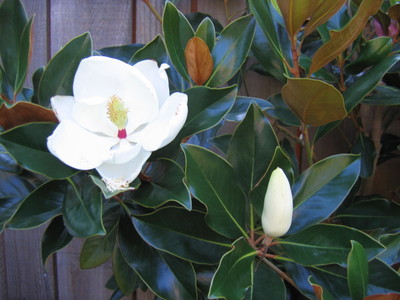
Magnolia blossoms

Opening to warmth and light

magnolia_blossomsLike those who show love

Growing near my parents’ new home, as well as in our own backyard, are magnolia trees–with their gardenia-like, sweet-smelling blossoms about the size your two hands make, when you shape them into an open cup.  The first line of this poem belongs solely to these magnificent flowers.  The second line describes the main forces that produce these beautiful blossoms.  Once we see the poem’s last line, the marriage metaphor works.  The beauty of ourselves in a loving relationship blossoms, when we remain open to warmth and light.  These things, in natural fact, make us more open, more sweet, more fully ourselves, which, in turn, enriches our time together with each other.

This poem is as much an invitation as a commemoration.  It honors my parents’ sixty years of marriage, while  inviting all of us at the table to remember the grand flowering of the magnolia.  Line two uses the progressive form “opening,” rather than the past “opened,” in order to strike this inviting tone.

The last line uses the verb “show” to make the point that feeling love is one thing, but showing it–so that others see it–adds extra light and warmth.  Unless I am a mushroom or a creature miles deep on the ocean floor, I need these things–just like everyone else.  I need to show them, too.

Leave a comment

Filed under creative solutions

Growing Writers, Season 2 Episode 1: Recycling

Leave a comment

July 8, 2013 · 10:31 am

homegrown haiku 5

Tall tree overhead

              Trunks sprouting like fireworks

                             Green celebration

In this haiku I wanted to render a tree outside my parents’ new home.  This tree, which none of us could identify, grows just off their patio.  It rises about forty feet, or so.  Its leaves are a translucent emerald green, and this poem is one of several in the series meant to help them remember beauty that surrounds them.  The tree is in their yard and will likely be there for a long time, but I wanted to leave a reminder of what they had already told us they liked.  It seems presumptuous to write a poem that tries to give something, like an appreciation, that they already have.  I suppose that the poem shows, more than anything, my desire that they enjoy their new home.  Like most writing, these poems are meant for someone else, while meaning at least as much to the writer.  The first line of the poem begins with a suggestion of protection.   The tree is tall, and its leaves create a canopy overhead to help shield my parents from sun and rain.

The second line made me work hardest; I wanted to capture the shape and arc of the multiple trunks.  They grow from a tight beginning then flare out and up.  I don’t recall the images I tried, but I like this one, and my niece’s endorsement confirms my satisfaction with it.  I suspect that I like the fireworks image not only for its physical description, but also for its association with the celebratory event.

p.s. I have attached no images to this post because I found none that match this particular tree.  Readers will have to use the poem to imagine it.

3 Comments

Filed under beauty, challenge, creative solutions, imagination, joy

homegrown haiku 4

Talking together

              Here and now makes a difference

                             Over many years

This haiku grows straight from a conversation with my wife shortly before the anniversary dinner.  Since the dinner celebrates a marriage, the impulse for this haiku fits.  Although some couples talk more than we do and some less, I value our ability to communicate openly and often.  Therefore, the first line represents the object of my appreciation.

In another run-on, an effect which I am starting to enjoy in haiku, the second line extends the general process to the present moment, making the abstract concrete.  Sometimes talking with your partner is difficult, awkward or even scary, but, in my experience, always valuable.  The reference to “here and now” grounds the lofty idea of communication.  Talk here and now, rather than wait for a “better” time–this is the spirit of line two’s opening.  Then, as it happens (I love the surprises that surface from composing, and from reflecting), the second half of line two not only completes the specific thought that conversation in the present matters, but it also produces an independent line two that says, “what you do now matters.”  This independent line creates a nice symmetry because it returns the poem to a general level.

Line three, then, moves back to the specific occasion of a sixtieth anniversary–with the phrase “for many years.”  While reminding us of this particular celebration, the last line also describes the accumulated value of openly communicating in the present.  The present is also the future.

Unlike the other haiku so far, this one has no central image–from nature or anywhere else.  In this sense, the poem stays more abstract than the others.  This feature may explain why I spend time noticing the layers of generality.  The experience of talking does not inherently produce a memorable concrete image; it is almost like live theatre, insofar as you have the conversation, then you have your memories of it and your associations with it.  The event itself has passed; only the impact and meaning remain.    In a way, this haiku #4 holds my memory of that conversation between me and my wife, Ann.  In particular, it captures my appreciation that we can have such talks, over many years.


Leave a comment

Filed under creative solutions

home-grown haiku 2

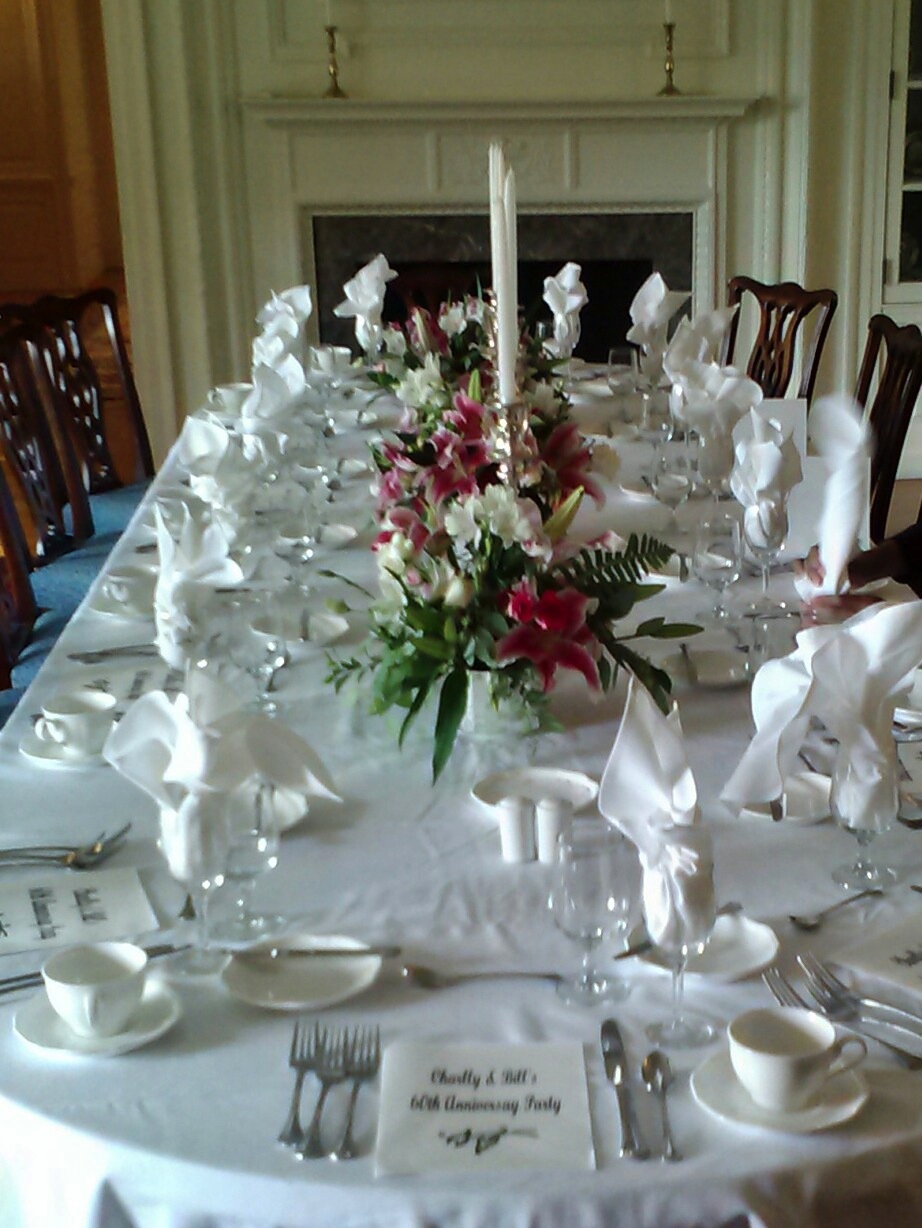
tableAnniversary

arrangements crawling with ants

life is everywhere

This is a zen haiku–because of the ants and the poem’s perception of them. (I use the popular, rather than the faithful, sense of the word “zen.”)

The syllables of the first line fit nicely.  In addition, as in the previous haiku, the first line runs on to the second.  The first line’s label stands alone, as an announcement of the event.  At the same time, it marries the next word in the next line.  This marriage signifies the flower arrangements seen in the attached photo.  Our mother arranged these flowers, as she has been doing professionally and personally for many years.  She loves finding the colors, shapes and sizes that fit the occasion and the table.  Some of my enjoyment in arranging words surely comes from her artistry.  As we tried out these several arrangements  the morning of the dinner, little black ants began emerging from the vases.  We tried brushing them away, squashing an occasional one, but they kept coming, kept crawling out of the ferns and flowers.  We decided to set the vases aside until evening, so that the insects could get their exercise somewhere other than on the dinner table.  As it happens, our plan worked.  The dinner was ant-free, as far as we could see.  The  image, though, stayed with me and crawled into line two of this haiku.  Yes, the ants appeared to spoil the table that morning, but this is my favorite line of the poem.  The phrase “crawling with ants” we hear often, and it fits here because it describes what we saw.  At the same time, the whole line captures the larger idea of arranging or planning anything, only to be disturbed by an unexpected presence.  The word “crawling” does not exactly match the number of little black feet parading across the table cloth–we saw an ant here and there–but it captures the oh-no feeling we had.

The last line, I used to think,  is my least favorite because it seems vacuous.  What does it mean, if anything?  The line actually grew from my wife’s suggestion that we move the vases aside that morning.  Her idea reflects the poem’s zen element.  If the arrangement is causing problems where it sits now, move it over and give it time.   To quote a favorite statement of hers, “If something is not working, change it.”  The ants, as the only concrete image, anchor the poem.  Flanked by an abstract label and an empty statement, their line moves the poem forward.  (Outside the poem, my wife’s suggestion brought a sensible, productive pause into the morning by recognizing the ants’ energy and moving it to another spot.)  This last, seemingly meaningless, line, though, invites an appreciation for all life, even the challenging parts.  This invitation suits the occasion of a marriage that has lasted sixty years.

Leave a comment

Filed under art, challenge, creative solutions, order

home-grown haiku 1

For my parents’ sixtieth wedding anniversary, I wrote several haiku to honor the event.  Since several of them need  explanation, which I gave during the anniversary dinner, I  offer that background here–for people who could not attend the dinner, for myself as writer, and for anyone else looking in.  While these posts repeat some of my impromptu comments, they also include thoughts surfacing since the dinner.

In the order of original composition (15 June 2013), here’s the first one:

Two together still

              Moving furniture pieces

                             To where they belong

Many who know me also know that my parents recently moved after having lived in the same house for fifty years, the house in which I grew up from age nine through high school.  Changing homes after that much time is hard, in several ways.  For example, it tests the relationship between those who are making the change.  This test is reflected in the first line.  The word “still” carries the idea of sixty years, which includes the recent struggle of picking up, packing up and re-locating.  The same word also means calm, as in “Before the sun rose that morning, the lake was as still as glass.”  Placing the word “still” at the end of the  haiku’s line reveals this second meaning more effectively than would, for example,  “Two still together.”

Although part of a haiku’s challenge is to create a total poem while allowing each line to read independently, as a kind of mini-poem,  I enjoy the run-on (spill-over) effect of “still / moving furniture,” which is what my parents were doing on the day of the anniversary dinner.  So, the stillness suggested in the first line contrasts in several ways with the lifting, carrying, placing, transporting and other move-related activities.

The third line, then, echoes the initial suggestion of stillness by claiming that things are as they should be, are where they belong, need no more moving.  The move that looked daunting several years ago has put in place not only furniture pieces, but also the realization that change is often both hard and rewarding.  Such realizations come more readily, when we can share the struggles and rewards with someone we love.

2 Comments

Filed under challenge, creative solutions, discovery, order