
I wanted to share this recent reflection by a girl in one of my high school senior classes.
She typically writes with such clarity and depth.
I wanted to share this recent reflection by a girl in one of my high school senior classes.
She typically writes with such clarity and depth.
Filed under art, beauty, challenge, discovery, imagination, reasons for writing
 One day this week, as the sophomores started reviewing each other’s blog posts, I spoke briefly to the whole group about pedagogy. Though not using that actual word, I raised this question: Why bother gathering at a physical place called school? The question allowed me to share my thoughts on the subject–thoughts that have been developing over the years spent with students in a physical place called the classroom. As I described my thinking to these sophomores, I asked them if they had heard teachers mention the idea of a “flipped classroom.” No one raised his or her hand, but soon after the silent response, one boy offered, “Do you mean students teaching teachers?” I told him, and therefore the whole group, that although I do not remember adults using those terms , I thought his idea was fabulous. “I want to remember your idea,” I told him. “Some time,” I added, “I can tell you stories about students doing exactly that.” For example, I remember a ninth grader in Tulsa who unwittingly helped me tighten my writing.
So, back to what I was telling the whole class, before this teenager “interrupted.” I was answering my rhetorical question, using the example of their in-class partner-proofreading. The most productive use we can make of in-school class-time–I am paraphrasing now– is for real-time social interaction–in the form of meaningful collaboration, for instance. Let students work together to help each other. Let them, for example, with our guidance, give each other feedback on their writing. The adult guidance is key, and we can layer samples, models, practices and demonstrations to develop the basic skills that enable productive feedback. But, as the adult conversations about flipping continue, I want to include the students–from time to time, not all the time. Occasionally, I find myself forgetting to extend the hand of respect to the students. I forget to offer that hand and bring them onto the boat. Sometimes, in my excitement to cross the river, I find myself on the other side, waving encouragement to the students who stand on the far shore. “Swim,” I yell. “Swim.”
The trust and respect that underlie healthy relationships must characterize my time with students, too. They are intelligent young people with distinct, valuable thoughts. Why not use all of our human resources, once we have come together in the same physical place called school?
Filed under challenge, creative solutions, discovery, trust
 These three letters represent a course I have been considering for some time: “Farms, Factories and Facebook.” In this course, students read literature, mostly fiction, that conveys the rhythms and mindsets of three ages in human history: agricultural, industrial and digital. We might call the third “informational,” but for now I am simply collecting titles and ideas. For the most part, this collecting has been happening privately. Feel free to comment with your thoughts. Feel free to launch such a course yourself. I trust we will acknowledge each other, when occasion calls for that.
Meanwhile, an article in yesterday’s New York Times profiles a Korean writer whose work fits my picture of this FFF course. Shin Kyung-Sook’s novel, Please Look After Mom, has made a lasting impression on my wife, since she read it about a year ago. When yesterday’s article appeared, we both said we want to read her other novels, I Will Be Right There and A Lone Room. The Times article describes the traumatic change in South Korea from an agrarian to industrial society–within just one generation. Ms. Kyung-Sook’s stories reveal what this dramatic disruption means to Korean families. The conflicts at the heart of the society reveal the distinct rhythms and mindsets of both eras. Therefore, one of these novels may suit the course I am imagining.
Other literature I have considered defines an era’s worldview from within–think Tess of the D’Urbevilles or Hard Times, for example–rather than across the “time zones.” Given my experience with home-grown courses like this, I want to find good stories– ones that engage students initially and years later, for their emotional and intellectual impact. Stories they carry with them. Analyzing the eras we humans have navigated is part of the course, but I have learned not to impose too much of my own historical ruminations on high school juniors and seniors. Those ideas provide a sturdy infrastructure, but individual students need to shape their own conclusions in their own way, largely through induction while reading these stories.
That’s it for now. Concerning this course, the time has apparently come to widen what Seamus Heaney calls the “circumference of understanding.” If you want to see and/or comment on the google doc of ideas and titles, complete the following form. Thank you.
Filed under art, challenge, creative solutions, discovery, empathy, expression, imagination, order
This week, the seniors and I have been working on the difference between a poem’s speaker and author. The following sequence of ideas arose this morning, while my wife and I drank coffee and talked on the deck, and while the sunlight touched the tops of our neighbor’s seventy-foot pine trees.
We saw his pine trees, as well as what used to be an equally tall oak, until a July storm dropped its top half. During this morning’s coffee talk, I recalled that our neighbor, let’s call him Paul Bunyan, finally began cutting the fallen limbs with his chain saw last night. Mention of the chain saw reminded me of Frost’s poem, “Out, Out,” which the seniors had recently read. In fact, some seniors may be using that poem for their first essay about tone; I hope I steal none of their thunder with this post. (Ssshh, don’t tell any of them about this post, yet.)
Naturally, at least for us two career literature teachers, Shakespeare entered the conversation–in the form of Macbeth, whose speech after Lady Macbeth’s death includes the phrase “Out, out, [brief candle].” When I repeated Frost’s title, my wife gave Macbeth’s next thought, “Life’s but a walking shadow” (5.5.23). At this point, my mind returned to this week’s work with seniors; I often find my mind going there.
Here, I thought, is a fine example of the energy created by the difference between speaker and author. My first thought on remembering Macbeth’s speech was that I disagree with his final claim that life is a “tale / Told by an idiot, full of sound and fury / Signifying nothing”–especially as I sat with my wife during this morning’s sunrise. Then I realized, perhaps in a freshly rich way, that so does Shakespeare. If he agrees with Macbeth, why bother writing all of these plays? At this point in the Scottish play, Macbeth has reached the very bottom of his despair and hopelessness. Ever since he has told himself that he is in bloody murders too steeped to turn back, he has been pursuing an untenable human course. He has separated himself from his most worthy being, as well as from other people. His moral coherence, his ethical integrity has been dissolving, unlike the blood on Lady Macbeth’s hands, which she cannot remove with her bootless cry, “Out, out, damned spot.”
Shakespeare, the author of Macbeth’s final desperate words, does see human life as signifying something, even while imagining a character who does not. In fact, through his art, the author tries to lead us away from such despair by enacting the journey that led to it. He wants to bring the lesson alive on stage.
And here, at this junction of speaker and author, I am reminded of a critical thinking skill that appeared on my recent blog post’s list of such skills. In this case, I am thinking of “shape meaningful schema.” Students who understand the play’s plot, Macbeth’s decline and the speech’s words are ready to combine these understandings with the author/speaker distinction, in order to shape in their minds a pattern that makes sense, that means something, that signifies something. With all due respect to Mr. Macbeth, I will keep making meaning–even out of his story. I will keep helping students do the same.
Filed under art, challenge, creative solutions, discovery, empathy, imagination, order, reasons for writing
I thought readers of this blog might enjoy a recent assignment described for my seniors. They have started writing reflections on poems they find in our text, and I gave this guidance for their first piece; these instructions grow from a sentence in Seamus Heaney’s introduction to his Whitbread-Award winning translation of Beowulf. Enjoy.
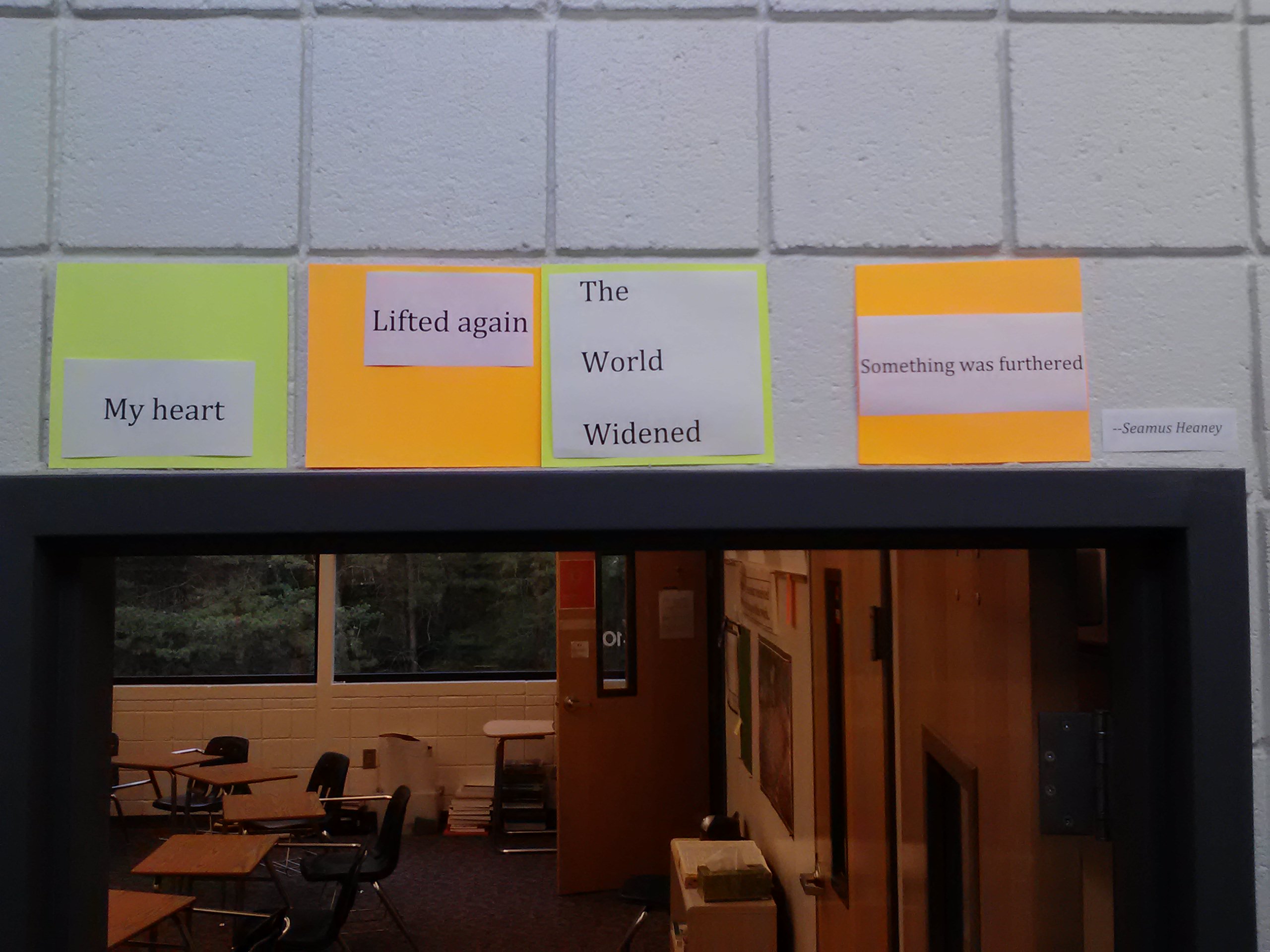
For this first reflection, base your writing on a single poem from chapter one of Mr. Kennedy and Mr. Gioia’s Introduction to Poetry. In the previous assignment for this week, I asked you to pick a poem on which you would like to reflect. As you consider this poem, use the quote from Seamus Heaney, seen in the photograph above. His brief statement comes the introduction to his translation of the Old English narrative poem, Beowulf, which we will start reading in several weeks. I posted his passage in a prominent place because I admire and value the thought and feeling behind it. In his introduction, he describes a particular struggle he experienced during the translation project. He struggled to reconcile apparently disparate parts of his past. His perseverance eventually led to a discovery that produced the statement above our door: “my heart lifted again, the world widened, something was furthered” (xxvi). I would like to use this statement as guidance for your first reflection.
In other words, use any or all of the statement’s parts as guides for writing a reflection of approximately 200-400 words; this will be the typical length for reflections posted on your blog. Let me explain my thinking about how to use the parts to Heaney’s statement. “My heart lifted”: Consider a poem that lifts your heart in a small or large way. Perhaps the poem as a whole does this, or maybe a single line. You can read “lifted” loosely. In other words, something about the poem satisfied you, or rang true, resonated, or made you say “yes” in some fashion. It made you feel fuller. “The World Widened”: As a result of your heart’s lifting, your understanding of the world, which includes yourself and other people, has widened. To borrow from Rilke, another poet, your orbit has grown wider. You see more because of this poem or this line. “Something was furthered”: This sounds like the previous part of the statement, but it also suggests that the world evolved in some way because your world widened. Some problem was solved, some insight gained. Some larger value was added to the world because of this thinking or feeling you are doing. Admittedly, this last part is probably the hardest to apply, but feel free to give it a go, if you are so inclined.
As you write your reflection, use my explanation of Heaney’s passage as guidance–rather than as a set of questions all of which you must answer. The fun and beauty of such reflective writings is that they give you a chance to notice and follow your responses. Let the associations happen, while challenging yourself to be as clear as possible–to yourself and your blog readers.
Have fun. Enjoy the writing.
Filed under beauty, challenge, creative solutions, discovery, joy, reasons for writing
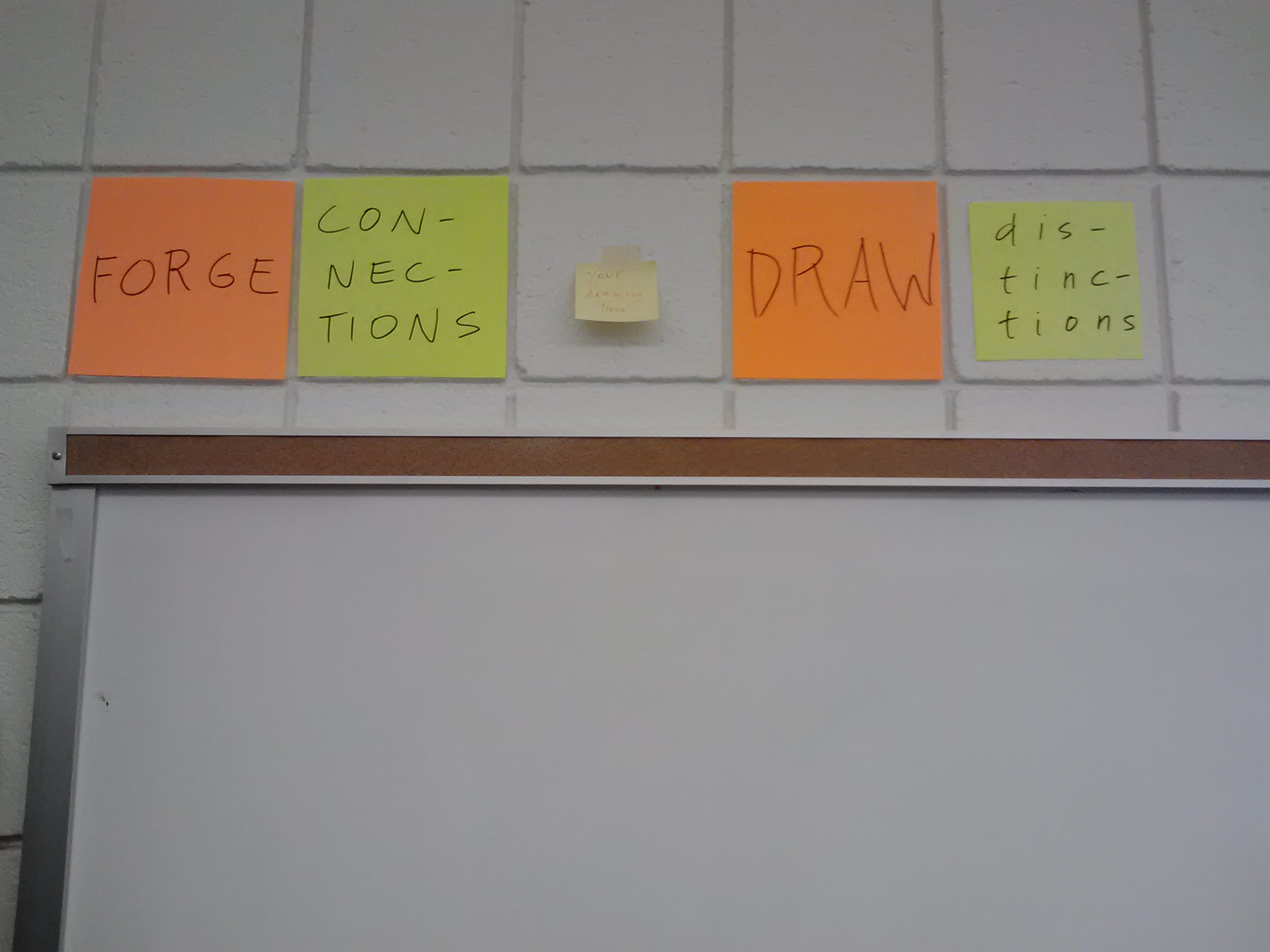 Since in our department we are discussing specifics in this area, I thought I would post my working list of skills, partly because I had fun generating the various verbs. I plan to test the efficacy of these labels by tagging homework assignments posted on our course’s blog. This may be a useful way to hold myself accountable for guiding students in exercising these skills. I am trying to make the list fairly inclusive while also manageable, and, as a bonus, memorable.
Here’s the working list:
forge connections, draw distinctions, make inferences, shape meaningful schema, create pictures, provide examples, make predictions, express questions
p.s. I wonder if I can string these together into a meaningful schema; I’m still playing with that possibility. As the picture shows, I am posting them above the white board, too–for regular reference and reinforcement. The little post-it signals the possibility of students’ placing an original piece of visual art to render each skill. Time will tell.
Filed under creative solutions
Making things is harder than destroying them. Who do you know who is a successful builder? What does this person build or make—houses, clothes, food, friends or something else?
For reasons I can’t reveal, I have created a significant number of writing prompts for original stories and essays. The complete list of these prompts will appear on class homework blogs this year, so that students can regularly use them to start a new piece of their own writing. Initially, I will likely limit the length, as a way to encourage the habit of writing and to enable more prompt comments. The list contains enough prompts that we could write one a week, and I may try to keep this pace at the start of this project.
I mention this project because I plan to participate. Maroonballoon will host my writings that can model the process for students. Students will have their own writing blogs, which will house their pieces from this project (for which we do not yet have a name), as well as regular reflections on the course readings.
The project and the student blogs are two more experiments. Like Whitman’s noiseless patient spider, we need to keep sending forth filament, filament, filament ’til a ductile anchor hold.
In my next post, I will start participating in this project–tentatively titled “growing writing” or “working the soil” or “regular writing.” The last one appeals to me, since it sets up student blogs for a complementary title, “reflective writing.” Or we could just say “prompts” and “reflections.” In any case, I will start with this prompt: Making things is harder than destroying them. Who do you know who is a successful builder? What does this person build or make—houses, clothes, food, friends or something else?
Filed under challenge, creative solutions, expression, reasons for writing
 Before I entered junior high school, my parents sent me to reading camp. I do not know all of the diagnostic details explained to my parents, but I do remember regularly struggling to read “fast.” Years after junior and senior high, I find myself telling others, including my high school students, that I struggled to read fast enough to care about the fictional characters I encountered. Why read, if you cannot care about the people involved? That became the underlying dynamic of my high school reading–in literature, history and elsewhere.
This remembrance of things past surfaces today, while reading reviews of Gita Mehta’s novel, Raj. A friend just told me he is considering one of her other novels, A River Sutra, for his Humanities class’s India unit. While reading about this novel and her other books, I encountered the following excerpt:
Without having read her books, I cannot agree or disagree with this or any review, but the quoted sentence sparks a memory of my early reading experiences. The maroonballoon blog has become, especially this summer, a place to remember and recount the dynamics of my own reading and writing. Time–in the close sense of summer vacation, as well as the broader sense of my career–invites me to reflect on the basic dynamics and associations within my own composing and comprehending. Awareness of these personal phenomena equips me more robustly, as another colleague might put it, to understand and guide students’ reading and writing. A heightened awareness allows me to communicate more convincingly, “I’ve been there.” It also enables me to spot their struggles and deconstruct the confusion they might be experiencing.
Now, as an older person, I enjoy reading and writing, though still struggling to read “faster.” I look forward, for example, to reading A River Sutra. I also will be reading Chief Justice Roberts’ majority opinion in the recent Affordable Health Care Act decision. I just enjoy reading stuff–of various sorts.
Reading a variety is important for students; they need to be flexible readers. This wide exposure strengthens–i.e., makes more robust–their writing. In my case, for example, reading the first pages of Justice Roberts’ opinion helped me write my letter of protest to the GA Dept of Revenue. Writers write their reading. Seeing Roberts’ careful wording and conceptual coherence inspires me to greater precision. So it is with students younger than I .
Today’s title, by the way, is meant to echo the label some people use to identify the law officially passed as the Patient Protection and Affordable Care Act of 2010 (Public Law 111-148). I know this blog post title captures a primary principle in my reading experiences, and I believe it reflects the best instincts of most people, as they consider the long-term health of all Americans.
Filed under challenge, discovery, empathy, expression, joy, reasons for writing
 The title echoes one of my early teaching bibles, Postman and Weingartner’s Teaching as a Subversive Activity. The main inspiration for today’s writing comes from a paragraph in Evangelia G. Chrisikou’s recent article, “Your Creative Brain at Work” (Scientific American Mind, July/August 2012).
After quoting the paragraph, I will comment on the teacher-as-disturber, the openings of Shakespeare’s plays and of Ed Park’s recent short story–as well as the role of poetry. Shakespeare wrote in the late sixteenth and early seventeenth centuries, and I did not know him personally, except through his writing. Ed Park, on the other hand, lives in NYC today, and I do know him, not only through his writing. For example, my wife and I had lunch with him in NYC several summers ago.
Here’s the quote about brains at work:
Although creativity has long been considered a gift of a select minority, psychologists are now revealing its seeds in mental processes, such as decision making, language and memory, that all of us possess. Thus, we can all boost our creative potential. Recent studies show promise for techniques that break down people’s established ways of viewing the world as well as strategies that encourage unconscious thought processes.
Here are the comments:
Recently, I have billed myself (sorry) as someone who likes to ask questions. In fact, I am currently reading a book called Make Just One Change: Teach Students to Ask Their Own Questions. If we are to help students by educating them, which from Latin means leading them out (presumably of themselves), we have to regularly ask thoughtful, thought-provoking questions, while giving students real practice at doing the same. The questions drive the work; otherwise, what’s the point of all this reading and writing?
I think of these moments in literature: the opening of Shakespeare’s Julius Caesar, with its raucous crowd of Caesar opponents and proponents (consider present-day Cairo); the start of Romeo and Juliet, with its feuding families; the haunted tower of Hamlet, with its disorienting apparition. In each case, the story starts with disturbance. So the story of student learning begins with disturbance, questions and subversion. What one has thought is tested; new theories, interpretations and understandings must be forged, shaped and tested.
Ed Park’s short story, “Bring on the Dancing Horses,” published in the journal Open City (Winter 2010-2011), begins with entertaining uncertainty. Halfway through a sentence, I realize the need to adjust the “horizon of expectations.”* The narrator, being ever so generous, helps me adjust my view. Here is the story’s first paragraph:
When I call my parents, my mom tells me my dad is busy teaching a class on the internet. That is, the class is in a classroom but the topic is the Internet. More specifically, he’s teaching seniors–that is, old people–how to blog, write anonymous comments on news articles without panicking, poke their children on Facebook, and get away with not writing h, t, t, p, colon, backslash, backslash, w, w, w, dot before every web address.
The best poetry breaks down “people’s established views” and “encourages unconscious thought processes.” I like to think of writing poems as a technique for doing this, with all due respect to what recent scientific studies show. Think of Billy Collins’s “Introduction to Poetry,” which asks readers/listeners to take a poem and hold it to the light like a color slide, or run their hands along its wall to feel for the light switch. Metaphors like these, when students read or make them, turn their lens, tip an object or idea this way or that.
So, in practical terms, what do these ideas mean for work with students? First, let’s acknowledge the role played by “essential questions” in many curricula. I understand the rise of this organizational method. At the same time, as indicated by my current reading, I believe the strongest school results come from students who know how, and are given the chance or responsibility, to ask their own questions, meaning questions that mean something to them.
This year, I have experimented with broad essential questions that serve the curricula I inherited when I changed schools. These questions have proved productive enough that I will likely use them again this coming year. I am finding that they generate students’ sub-questions. Here are the essential ones I have used. The number shows grade level.
12 Where do we find struggle, internal and external? Where do we see monsters or demons, and what makes them so? What influences our responses to these struggles and monsters?
10 Who am I? What are my primary responsibilities to myself and the communities in which I live?
For context, I should add that the senior classes began with Beowulf, while the sophomores opened with Oedipus Rex. Imagine how you would apply the questions to these texts. Also, I should add that Seamus Heaney’s introduction to his translation–the one we use–includes an account of his personal linguistic struggle, having grown up in Northern Ireland. In patiently facing this fundamental challenge, he produces a statement that hangs above the entrance to the classroom in which I teach: “my heart lifted again, the world widened, something was furthered” (xxvi). It turns out that the linguistic history of the Old English word meaning “to suffer” resolved Heaney’s personal struggle.
So, let’s keep an eye on established views, while asking questions that may disturb. We can ask such questions of the material students are experiencing, but we can also ask them of ourselves as educators. For example, what are the “established ways of viewing the world” among today’s teachers? Who establishes them? How do we determine that they are, in fact, established?
Filed under challenge, creative solutions, imagination, order


 maroonballoon