pattern recognition

I find myself repeating myself.

As I wrote yesterday’s post, I found myself repeating myself.  In other words, ideas or phrases kept re-emerging, floating to the surface of my attention.  For example, the gaps I mean–to echo Robert Frost’s poem, “Mending Wall.”  The idea of gaps cycled back through my attention, and I enjoyed its return because that gave me momentum.  The momentum was fueled by the fun surprise of the re-emergence; I did not plan so much as discover it.  A bit like turning over soil and discovering worms wriggling about.  Once the idea of gaps returned for the first time, I began seeing it as a recurring theme that I could intentionally nurture.  A structure of sorts emerged, or a motif.  I could then identify and develop different kinds of gaps.  Sometimes I impose structures beforehand, but at times like this, the frameworks emerge more organically.  In these vacation reflections, I can play around with this organic material.

So what about pattern recognition?  This is a specific skill within the broader ability called problem-solving.  Teachers need to help students develop this specific skill, and literature study provides a tool for this training.  So does reflective writing.  One benefit of my playing around with this organic material–there I go repeating myself–is that I can practice pattern-recognition.  In this particular case, I have seen a concept repeated.  The start of a pattern happened unintentionally, for the most part; I then continued the pattern on purpose.

link to previous post

Students benefit from being able to “listen” to the sequence of their own ideas.  Reflective writing can provide practice at “hearing” recurring concepts in their mind.  Those patterns, I have found, serve as productive launching pads for their individual writing.  Their voices are more likely to emerge in writing that builds from patterns in their own minds.

final comments

I enjoyed seeing the idea of gaps recur.  This recognition had the ring of revelation.  Maybe not to the scale of Joyce’s epiphany, but it had a spark of joyful learning nonetheless, and that’s my main reason for sharing it.  Many writers no doubt have already firmly learned this feeling of pattern recognition emerging from their composing, but–to paraphrase Neruda’s “Ars Poetica I”– I am learning this by working with my own hands, which is the kind of learning I hope for students.

Yesterday, I hung some dill branches in the shed to dry.  Later, we can use the dried seeds to flavor dinner dishes or to plant new seedlings.  In either case, the dill work reminds me of an idea for my youtube series, growing writers.  That series explores connections between gardening and writing.  In the case of dill and yesterday’s post, I have harvested the idea of gaps  for future use.  Since the seeds are drying, I can use them any time I want–to flavor a meal or grow more plants.

Leave a comment

Filed under challenge, creative solutions, discovery, expression, joy, reasons for writing

leave room, or Raiders of the Lost Art

In this post, I reflect on listening.  If neither title above makes ultimate sense to you, try this one:  Quiet, the bee is sleeping.  On a recent morning, as I was walking near our deck, I glanced inside a small gap–half the width of my little finger–between one of the corner posts and the railing.  In that gap, I noticed a black-and-gold bumble bee sleeping in the pre-dawn quiet, undisturbed.  I enjoyed finding him resting there, and, although I never heard him per se, the twilight atmosphere in which I made the discovery captures a component in the process of listening.  The following reflections on listening grow from a confluence of recent experiences.  Time away from the formal academic year gives me a chance to reflect more richly on such confluences than I usually do during official school days.  I find it helpful to remember this gap vacation and school modes because I often encourage students to reflect, but I need to understand, and take  into account, the various levels and kinds of reflection.  Many school cultures struggle to encourage depth of thinking, especially reflective thought.  Granted the age gap between me and my students makes a difference; I am more inclined to look back on years of experiences.  Even so, my own reflective explorations help me help them.  Somewhat regardless of the depth, I can pull from these writings an appreciation for associations.  How do the chains work?  How, and when, do we most meaningfully notice these links–be they conceptual, sense-related or other.  As I have written elsewhere, and believe as firmly as ever, our mind is powered by association.  We are natural poets all.  Reflective writing opens the window on associations that our brain is making with or without our attention.  

Enough preamble. 

Three days ago, I wrote a letter.  Yes, by hand.  I wanted to congratulate a sophomore whose hard work this past year had produced the most original final exam essay.  When he emailed that essay, he apologized for not having achieved higher grades.  He also, truth be told, said that he enjoyed the class.

In my letter, I asked the student not to apologize because he had faced his challenges with resilience, persistence and unquenchable curiosity.  The final exam asks an intentional sequence of interconnected short-answer questions about The Kite Runner.  Students who were aware of the ideas developing in their answers had the raw material to address the essay question, which they knew would focus on the topic of moral courage in three books: Alvarez’s novel, In the Time of the Butterflies; Wiesel’s memoir, Night; and Hosseini’s novel, The Kite Runner.   On the top of the short-answer sheet, this student wrote “Finally figured it out!”    Just beneath that declaration, he drew a wide, narrow rectangle in which he wrote: “Main Theme of Book: Guilt: living with guilt and finding a way to be good again.”

Yes, he has struggled this year–struggled to understand.  But that’s exactly the point.  He has not backed away from this challenge.  I am not surprised, but certainly am pleased, that his persistence produced such a distinctive essay.  The writing rings with his own voice, which means his own mind.  He has carved out a meaning that works for him.  Ironically, that meaning involves the ideas of guilt and becoming good.  Consider his email.  This ironic connection reminds me that learning is personal.  While he accurately identifies a major theme in the novel, he also has named a major theme in his course work this year.

How, then, does this episode embody the idea of listening?  In two ways.  First, when I read student essays, and perhaps especially exam essays, which are designed to show individuals’ making new meaning from the course materials and discussions, I listen for their voice, their original interpretations.  Second, this student, with his email apology and exam-sheet declaration, is listening to himself.  He knows that he has crossed over into the satisfying land of understanding.  He is aware of having solved a conceptual problem.  He has spotted the bumble bee sleeping in the gap.

connection

Two days ago, I met a good friend for lunch.  We talked about our families, our jobs–about growing things, making things and trying to figure some things out.  Has has recently written about listening; at least, that’s how my memory of his blog post emerges at the moment.  In particular, he recalls asking William Stafford, “What is at the heart of great teaching?”  Stafford answered, “Find out where your student is, and help him get to the next step.”  Do you hear my connecting Stafford’s response to the idea of listening?  I have always valued listening–in myself and in others.  I am grateful for Stephen’s question and Stafford’s answer because they make me feel good about my work with the sophomore boy mentioned above.  Struggles like his can take a long time to bear noticeable fruit, but we need to remember that the fruit does fall and that it takes time to do so, which is something else that Stephen and I talked about during lunch. (Incidentally, I think of educators’ recent pleas, especially in the context of technology conversations, to meet students “where they are.”  I respect this plea, and therefore want to  understand the various ways in which we teachers can do this.  Some of these ways involve may involve facebook or youtube, while others involve letters and essays.)

another connection

Finally, I have been thinking about Dave Eggers’ book, Zeitoun–an account of a New Orleans family’s many struggles during and after the Katrina disaster.  I highly recommend it.  Pretend America is a person whom you have just asked for a story.  “Tell me a recent story,” you say, “that shows how good you can be, but also how your complicated nature causes needless suffering and indignity.”  Zeitoun is the story America tells.  As for the connection to listening, I am thinking of an image that runs through the book, and appears on the cover:  the main character’s paddling his canoe through the flooded streets of New Orleans.  He is able to help a number of city residents, people and dogs, because his craft proceeds quietly enough that he can hear suffering.  He listens for it and responds.  Part of his reason for staying behind in the city, while his wife and children have evacuated, is so that he can help people.  Listening from his canoe allows him to do this over and over.

Final comments

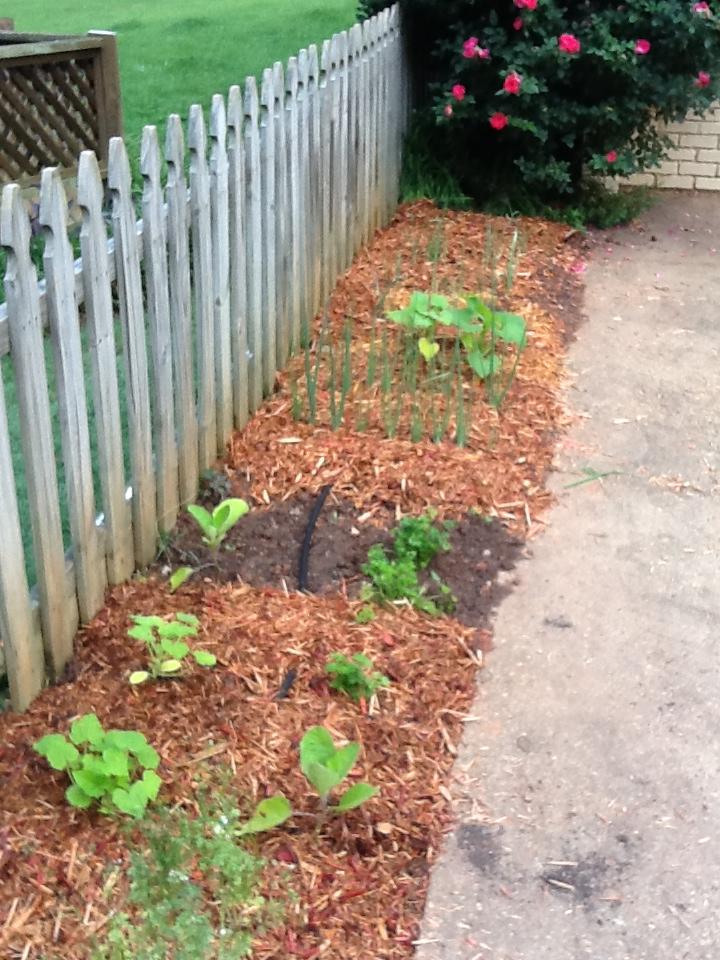
The title, “Leave room,” refers to my leaving room for students to grow, to “get to the next step.”   Of course, leaving room involves more than just listening, but listening allows me to design the space into which they can grow.  This idea of growing into a space explains the garden photograph I have attached.  You notice that I have left room for the parsley to expand; I may also transplant the tarragon into some of that space.

The title, “Raiders of the Lost Art,” suggests that aspects of today’s culture discourage listening.  At the same time, the title suggests a question: “Who, or what, are the Raiders?”

Leave a comment

Filed under challenge, creative solutions, empathy, imagination, trust, work

insistence

Today’s title comes from an epigraph to Stanley Kunitz’s book, The Wild Braid: A Poet Reflects on a Century in the Garden, written with Genine Lentine and photographs by Marnie Crawford Samuelson (Norton, 2007).

Here’s the full epigraph, presumably written by Kunitz:

I associate the garden with the whole experience of being alive,

and so, there is nothing in the range of human experience

that is separate from what the garden can signify

in its eagerness and its insistence,

and in its driving energy to live–to grow, to bear fruit.

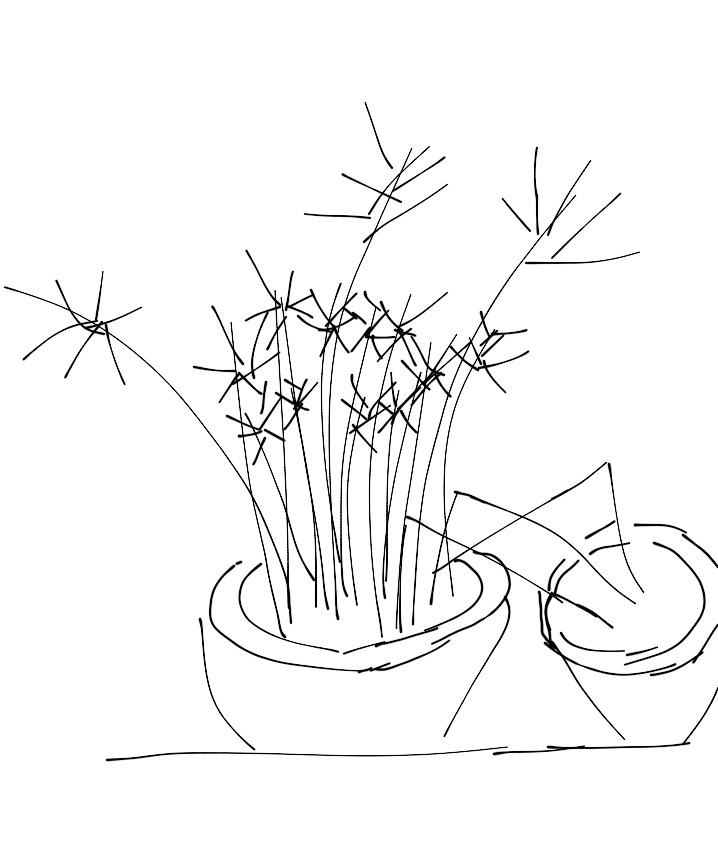
Not so much because of this verse, but concurrent  with its spirit, I started sketching a poem about the papyrus that sits in a pot on our deck.  As I was writing the poem, Kunitz’s word insistence, which I italicize in the epigraph for emphasis, found its way into my verse.  I had started the poem by noticing anew what I have known for some time–that the papyrus reproduces itself by leaning heavy fronds into neighboring waters, which means, in this case, that it plants itself in the next pot over from the mother pot.

Here’s a draft of my poem:

Bowing towards the river

Like the papyrus,

heavy with new growth,

a few of my fronds bend,

forming right angles,

bowing to sip from the river–

all from insistence to sprout yet

another draft of myself.

In the background,

in the young dogwood

slightly taller than myself,

two chickadees dance among the branches,

barely hidden,

watching for their turn at the bird bath.


Note:  After finishing this draft, I turned the sprinkler on the dogwood and bird bath because not only the chickadees, but also the cardinals, wrens, titmice and sparrows were all clamoring for their morning ablutions.  As I write at the window inside, which overlooks the deck and the dogwood, what started as a little chickadee dance has become a full-fledged aviary extravaganza.

2 Comments

Filed under beauty, order

there’s a divinity that shapes our ends . . .

. . . rough hew them how we will

What follows is a flow chart of ideas prompted primarily by an article about the current broadway revival of Miller’s Death of a Salesman.  I read the article about a month ago. Some day–perhaps some day soon–I will convert this sequence to a coherent collection of sentences.  For now, I just want to record the chain of associations–the code, as it were.

this line keeps meaning more to me with time, and help.

today I read DOS article, C Isherwood in NYT

then outlined my response to final Hamlet essay question for seniors

which took me to this line, and the Cambridge gloss

after which I thanked my wife for clipping the DOS article

which led to our talking, almost tearfully, about the depth and resonance of Miller’s play

which led me back to this line that acknowledges importance of intuition

which reminded me of Miller’s description of his composition–for example, his hoarseness, the quickness and few revisions

which took me to remembering Darrick’s influence on my work

which made me realize the gap between what I had meant to mean for Darrick, what I now see in the line

all of which does not diminish my feelings about Darrick’s influence, but simultaneously refines my understanding of Sh’s line and its application to Miller’s distinctive place in American drama, and world literature

Leave a comment

Filed under creative solutions

spring harvest 2

To follow up on the previous post, here is a piece of senior writing from the mid-year exam.  The first half of the two-hour exam assessed skills in analyzing poetry.  The second half presented this question:

Monsters

Whereas the epic poem, Beowulf, draws distinct lines between its monsters and the protagonist, Mary Shelley’s novel, Frankenstein, blurs these lines.  Do you agree?

 If so, what is the most important effect of this blurring on an understanding of the term “monster”?

 If not, what important aspect of the term “monster” operates equally in both the poem and the novel?


And here, slightly edited, is one of the more elegant responses I read.  I am more than happy to share it.

________________

An archetypical monster is a malicious creature that terrorize[s] without remorse, but Mary Shelley takes a different approach  and allows the reader to sympathize with the “monster” in Frankenstein. Mary Shelley’s “monster” is conflicted because wants he [he wants to] feel love, but his constant rejection turns his plea for love into a sense of loathing. “I vowed eternal hatred and vengeance to all mankind” (108). He gives up hope that humans can be kind creatures. He only reciprocates  the monstrous behaviors that humans have shown him because he has not been taught any differently. Although the “monster” is ugly and seemingly vicious, there is a kindness in his heart that archetypical monsters do not possess. “I could have torn him limb from limb…but my heart sunk within me as with bitter sickness, and I refrained” (103). Shelley creates a sense of compassion for the “monster” because he chooses not to fight back when the cottagers attack him. The “monster” is the victim in this scene and the cottagers can be called monsters themselves for attacking a creature with good intentions. After facing constant rejection and terrorizing Victor Frankenstein, the “ monster” is remorseful. “I look on the hands which executed the deed; I think on the heart in which the imagination of it was conceived, and long for the moment…when it will haunt my thoughts, no more” (178). He is haunted by the memory of his actions and longs for a time when he does not have to feel the agony of his actions anymore. Mary Shelley blurs the lines and creating a monster that does not align with archetypical monsters. The reader is able to identify with the “monster’s” internal struggle to fit in with society rather than fear his “monstrous” qualities.

Leave a comment

Filed under creative solutions

spring harvest

In some places, fall is the time to harvest.  In most schools where I have taught, spring is that time.  The traditional academic year is ending, and we can look back on what students have produced during our time together.  I have one such piece in mind, for now, because when I first read it, it signaled gratifying growth for this student, a girl in the tenth grade.

First a word about the exercise.  We had recently read Elie Wiesel’s Night.  During our reading, I had introduced a particular method for noticing and recording details in this memoir.  After pointing out a feature I had missed or forgotten–that the chapters contain what I came to call episodes, set off visually by extra spaces and capital letters–I asked students to start creating titles for each episode.  I showed them some of my titles: “family strength,” “God’s mystery” and “playful bystanders.”

Once we had finished the book, I asked students to write down three different episode titles that especially resonate with them.  (This idea of resonance we have been using all year, and evidence suggests  that they have come to understand this idea.)  Then, from these three titles, they state an idea about Wiesel’s experience.

After everyone has written his or her statement, I compile the ideas on a single list.  Since I teach two sections of this class, I give the Section A list to Section B, and vice versa.  On this sheet, students rank the top five statements:  How clear is the idea?  How easily and productively could you develop this idea into a brief essay?  After the ranking, each person chooses to develop one.  Most of the time, students choose their number one idea.

Before I attach the featured writing below, I wanted to give this background, so that readers know the process of arriving at the range of main ideas being pursued.  The students generated these ideas–by reading carefully, recording their summaries, noticing resonances, making connections and noticing patterns among those resonances, expressing a single idea about someone else’s (Wiesel’s) experience.  After evaluating other students’ single ideas, they choose one to develop.

As I said, this piece represents significant growth for this writer.  Also, this brief essay contains several strong examples of parallel structure.  I don’t know how much responsibility belongs to a particular lesson earlier in the year with Lincoln’s Second Inaugural Address;  I said nothing about this rhetorical device in the Night instructions.  Seeing these examples, however, lifts my spirits.  I love seeing young writers notice and use such tools to express themselves.

So here is the unedited student piece:

If you witness your family, friends, neighbors, being incinerated would you still believe in God? As fear consumed you could you stay strong? That is exactly what the Jews in the concentration camps had to endure as they were stripped of their names, clothes, and all dignity and forced to work as cheap labor. In the novel, Night, by Elie Wiesel, the concentration camps engender doubts about the Jews’ faith, which eventually leads to their loss of God completely and their gain of fear. Fear is powerful; it can move mountains, shake cities, even cause you to lose all hope. What are you left to believe in?

“Not far from us, flames, huge flames, were rising from a ditch. Something was being burned there. A truck drew close and unloaded its hold: small children. Babies! Yes, I did see this, with my own eyes… children thrown into the flames” (32). Wiesel shows readers continually how death surrounds the camps. The Jews were powerless against the guards so they turned to God, praying for Him to end the suffering. When God did not come to the rescue of the Jews, they began to question if He was actually there. How could He let them suffer like this? Where was He? Many of the Jews thought they were in some kind of a never-ending nightmare: “Was I still alive? Was I awake? How was it possible that men, women, and children were being burned and that the world kept silent?” (32).

As the questions pile up, anger over their suffering did too: “For the first time, I felt anger rising within me. Why should I sanctify His name? The Almighty, the eternal and terrible Master of the Universe, chase to be silent. What was there to thank Him for?” (33). However, this anger soon dies as weakness begins to consume all of their bodies. They have been beaten, forced to run naked through the cold, and given numbers instead of names. Fear begins to creep into the peoples’ heads. If God isn’t here to help us, who is?

The Jews felt abandoned and their faith was put to the final test. Some remain strong, but many fall to the mercy of their own fear: “Where is God’s mercy? Where’s God? How can I believe, how can anyone believe in this God of Mercy?” (77). Because they have no one to believe in, there is nothing stopping them from losing all hope. ‘There is no way we will make it’, that is what all of them are thinking. So, they give up; they sit quietly, in their fear, and wait for death to find them. When it comes, they do not fight it, they go quietly into darkness. This is what Wiesel is trying to show in this book, just how horrible the camps were. He wants the audience to remember his peoples’ suffering, and the pain he was caused.

Leave a comment

Filed under creative solutions

PPA

In breaking new ground on a video project, I have learned quite a bit already about filming.  Given my early struggles with the medium, I have created a table to use with students, who also encounter problems in and out of school.  I want to pick my spots for trying this instrument, but also wanted to share it sooner than later.  As you might imagine, I can already add entries to the first column.

To see the latest program in the video series, turn to growing writers 2 radishes.


Project Problem Analysis 

Project_____________________________________________________   Date(s)________________________


PROBLEM SOLUTION METHOD(S) for finding the solution
Youtube does not accept images, but only movie format Convert photo booth image to iMovie file Use “Help” menu in youtube home page


Leave a comment

Filed under creative solutions

growing writers: tools of the trade

An old guy tries a (relatively) new trick.

We will see how this experiment goes:

http://www.youtube.com/watch?v=40p8UxQHGFo&feature=youtu.be


4 Comments

Filed under creative solutions

Oh my rank is an offence

The Hamlet reference in the title comes from our work in senior English yesterday.  We were examining Claudius’s dialogue with himself in his private chapel.  That speech opens with the painful, confused acknowledgment, “Oh my offence is rank, it smells to heaven” (3.3.36).  Since this post is basically about modeling learning, I have flipped his statement–for fun, even though the result sounds more urgent than intended.

On the way to this class, last period Friday, I walked with a senior who had attended a lunch session organized by the Student Diversity Leadership Council.  They had invited Frank McCloskey, Vice President for Diversity at Georgia Power.  He spoke in the library about his experiences before and in that position, a post he has held for ten years.  I would say that about sixty people chose to hear Mr. McCloskey, including this senior, myself and four other students from the last period class.  All five of us stayed to the end of the SDLC session, which made us about ten minutes late to class.  I consider those ten minutes a valuable investment, for a variety of reasons. For example, our late arrival gave me the opportunity to apologize to the whole class, from which naturally grew the chance for the four students to explain to their classmates where we had been and what we had heard.  As each attendee summarized his or her impressions, I had the opportunity to hear that individual response.  Afterwards, I added my response.  As it turns out, our being late pushed me to do what I had wanted to do anyway–make known to a wider audience the substance of the valuable program.

Anyway, as I was walking to class with this senior, I asked her what she thought of the session.  She remarked on Mr. McCloskey’s idea that leaders often influence others in ways they do not realize.  As an older sister, for example, she was struck by the notion that her younger sister looks up to her, and follows her model, more than she knows.  I think Mr. McCloskey addressed this notion within the context of his topic, “trusted leadership.”

In the next post, I will describe a brief episode, also from yesterday, about modeling learning.  More and more, I am convinced of the power of our modeling learning for students.  Making mistakes is part of learning; we have to be able to do this, and to let students see us do this.  Such transparent modeling gives us the natural opportunity to also show them how we respond to the mistake.  For example, how well do we adapt to the unexpected result?  In other words, how do we make thinking visible to them, as we learn from our mistakes?

p.s. Our department is discussing “thinking” as a skill.  If we reflect on how we make our own thinking visible–to ourselves and our students, we may have opened a window on what me mean by this term.  We may have opened a second window–on how we design work that makes the students’ thinking visible.  I know I have heard others speak and seen others write on this topic; Project Zero, I think, has done work in this area.

2 Comments

Filed under creative solutions

to live on the hillside

As has happened more than once–ask my wife–while walking through a room in our house, I spotted a book.  This time it was Wendell Berry’s Standing by Words: Essays (Washington, DC: Shoemaker & Hoard, 1983).  I pulled it from the shelf mostly because of yesterday’s post–about not wasting chances to grow something.  Passages from Berry’s book have fed me ever since I found it in Durham, NC some years ago.  One of its passages I have framed; it hangs in my office at work. It describes the value of discipline.  Yesterday’s post about saving radish sprouts made me want to review a few passages I had tagged in the book.  I found two to include here.

As some readers may know, Wendell Berry likes to write about farming. In fact, the following excerpts come from his essay called “People, Land, and Community.”  I enjoy and appreciate his descriptions of agricultural rhythms, especially in this our increasingly digital world.  I find comfort and value in his discussion of time.  It simply takes time to grow things, and discipline to stay with the same soil.  I am starting to hear echoes of the teaching profession in passages like these below.

“But to think of the human use of a piece of land as continuing through hundreds of years, we must greatly complicate our understanding of agriculture.  Let us start a job of farming on a given place–say an initially fertile hillside in the Kentucky River Valley–and construe it through time.

“1. To begin using this hillside for agricultural production–pasture or crop–is a matter of a year’s work.  This is work in the present tense, adequately comprehended by conscious intention and by the first sort of knowledge I talked about–information available to the farmer’s memory and built into his methods, tools, and crop and livestock species.  Understood inits present tense, the work does not reveal its value except insofar as the superficial marks of craftsmanship maybe seen and judged.  But excellent workmanship, as with a breaking plow, may prove as damaging as bad workmanship.  The work has not revealed its connections to the place or to the worker.  These connections are revealed in time.

“2. To live on the hillside and use it for a lifetime gives the annual job of work a past and a future.  To live on the hillside and use it without diminishing its fertility or wasting it by erosion still requires conscious intention and information, but now we must say good intention and good (that is, correct) information, resulting in good work.  And to these we must now add character: the sort of knowledge that might properly be called familiarity, and the affections, habits, values, and virtues ((conscious and unconscious) that would preserve good care and good work through hard times” (71-72).

There you are then.  One of my marked passages from Wendell Berry’s book.  Living on the hillside is like living with the students.  Knowledge and memory, affections and patience–we depend on these for results that emerge later, sometimes much later, in time.

photo credit: http://www.havenandhearth.com/forum/viewtopic.php?f=5&t=10185

Leave a comment

Filed under beauty, challenge, creative solutions, trust, work