
Here’s a fun little video on the subject–from a friend and colleague who teaches Science, mostly Physics.
Here’s a fun little video on the subject–from a friend and colleague who teaches Science, mostly Physics.
Filed under creative solutions
To honor colleagues who have coordinated monthly conversations as part of a Professional Learning Community (PLC), I want to share “Exam Principles” that I recently explained to my students. Tomorrow’s PLC conversation topic is the value of final exams.
Principle #1
Patterns, comparisons, synthesis => new realizations, recognitions, insights
Principle #2
Express realizations, etc, => state clearly, develop convincingly
Principle #3
Handle new problem / challenge / complexity => reasonable, confident solution
A summary of my explanation to students
Since we have read plays and novels more or less in isolation, the exam is a chance to consider titles together. The exam, therefore, invites you to discern patterns, make comparisons and synthesize ideas. Through these processes, you create new realizations, recognitions and insights. The exam is a time to forge new observations and interpretations, rather than repeat old ones you and I already know about.
Equally important, the exam questions your ability to express–in conventional essay form–these new insights. The two main tasks are to state your idea clearly and to develop it with an array of compelling evidence.
Lastly, and more generally, the exam gives you questions (problems) that you have not yet encountered with this reading material. It tests your ability to face a complex challenge and develop a reasonable answer.
This time, students will have two separate questions, each to be answered in essay form. The questions take into account the above principles.
Filed under creative solutions
“It is common throughout the history of man that the failure of individuals to respect and recognize the beliefs, culture, and commonality of other human beings leads to, or creates, strife and grief. The inability or unwillingness to understand, also known as ignorance, is a generator of strife and grief.”
Although just a first draft of an essay’s opening, these two sentences by a sophomore boy inspire me. They remind me that the young people with whom we teachers work have deep appreciation for life’s challenges. The job of adults in school communities is to give them chances to express such appreciation in ways that mean something to them and those around them.
Filed under challenge, discovery, expression, reasons for writing, trust
As students rev up their poetry engines for next week’s poetry contest, I wrote this to feed the soil of their souls. I think that extending “filament, filament, filament” of ideas and models enriches the possibilities of their own creations. Plus, I thought other people besides my students might enjoy these poems.
Recently I started reading a book called Love Poems from God: Twelve Sacred Voices from the East and West, translated and introduced by Daniel Ladinsky (Penguin, 2002). The first chapter contains poems by Rabia, an Islamic woman writing in eighth-century Basra. Some of you may know that Basra lies in present-day Iraq. Her poems remind me of topics I offered you lastFriday as starters for this coming week’s poems.
Hafiz
Before showing you some of Rabia’s poems, I want to give you one by Hafiz, the Persian poet who lived in present-day Iran, five hundred years after Rabia,. This poem appears in another of Ladinsky’s books, The Gift: Poems by Hafiz, The Great Sufi Master (Penguin, 1999). I offer it here because it connects to our essential question about behaviors and beliefs that cause strife and grief. Hafiz’s poem, “The Sad Game,” goes like this:
Blame
Keeps the sad…
View original post 378 more words
Filed under creative solutions
This student has located Shakespeare’s TEMPEST squarely in a local, contemporary problem, and we have just barely finished the first act.
Filed under creative solutions
A humbling and inspiring account of a teacher’s return trip to Haiti.

This past week, I traveled again to Leogane, Haiti to a small school, St. Matthieu Episcopal School. It was not a mission trip, and I am not a missionary. In fact, if anyone was sharing or living the gospels, it was the Haitians, and I am the beneficiary of all that they teach me about faith, hope, and love.
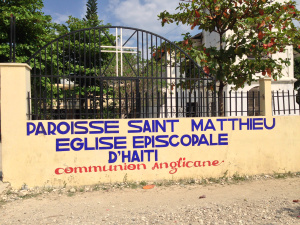
I’m a teacher, and I believe in the power of education. I keep returning to Matthieu because the parents in the community desperately want an education for their children, and their children love to learn. In Tracy Kidder’s book Mountains Beyond Mountains, which chronicles the work of Dr. Paul Farmer in Haiti, he emphasizes the value of building schools, which may seem like poor triage when you consider the level of homelessness and hunger that prevails. However, one peasant woman explained why school is critical to Haiti’s future, “A lot…
View original post 1,671 more words
Filed under creative solutions
 When Shakespeare’s play opens, Hamlet’s father has been killed without anyone knowing how or by whom. All Hamlet knows is that his father was taken unprepared, which for Elizabethan audiences means he had no chance to confess his sins before dying. He was murdered before he could confess.
Ironic, since his murder was a sin.
This idea of murder–in both its literal and figurative senses–underpins my post. Recently, I have recalled a family member’s memory, heard a friend’s story and read a newspaper essay on related subjects. Each of these instances makes me wonder when and how competition, understandably rooted in nature, turns to murder of one sort or another.
In the memory I recalled, a young businessman with a wife and three children, was making plans to acquire the company for which he had been working. He and his two partners were nearing the final arrangements of their joint purchase. When the young man returned to his office early Monday morning, he saw two extra cars in the parking lot. Normally, he was the first to arrive. He began to suspect. As he approached the building’s glass doors, his “partners” stepped out to tell him he did not work there anymore. They owned the company, and he no longer had a job. Who knows where he drove first, as he pulled out of that parking lot?
The friend’s story overlaps significantly with the young businessman’s. In short, people to whom he had spoken in honest confidence rewarded him by lying in front of others about their conversation. They publicly declared he had never spoken to them. This “bold” lie created a tempest of worry, pain and confusion. And, as often happens, the storm proved people’s mettle. For example, not one person during that public declaration grabbed the helm or even offered a raincoat. Speaking of “bold.”
The newspaper essay from today’s New York Times describes global strife during the seventeenth century– fittingly, the same century in which Shakespeare wrote The Tempest. This essay addresses the role of natural events, like increased volcanic activity, in contentious relations among people and states. Such trying times, such competition for food and other resources, such struggle to survive–all show us who is who.
Although I understand the need to physically survive, and the competition that natural events sometimes heighten, I do not understand all of the factors at work when “partners” turn on other members of their group. What makes them knowingly injure, bewilder and “kill” someone with whom they have been working? Certain psychological mechanisms or emotional needs silence our capacity for compassion. I wonder what they are. I believe that if more people understood these mechanisms and needs, we would have fewer personal stories like those above. What sends us on these murderous quests?
photo credit: http://www.medievalweaponinfo.com/wp-content/uploads/2011/09/daggers.jpg
Filed under challenge
 In order to keep their course blog uncluttered, I am writing here for some of my students–those who want to see a model of their weekly assignment. They are publishing regular posts on their blogs. In each post, they reflect on our two essential questions (EQs)* through the lens of The Tempest. I will use the same questions, but write through the lens of Hamlet, so as not to steal their thunder. Whenever I can, I do writings like this so that I can a) show students that I enjoy writing b) give them a sense of what I am asking them to do and c) engender trust by demonstrating that I understand the assignment from the inside. Students are more likely to enjoy and learn from assignments if they a) enjoy them b) understand the instructions and c) trust that the teacher is assigning something other than busy work. Below are the two essential questions and my first installment. For those playing at home, the students’ first post is based on The Tempest up to Act One Scene Two, line 321 (1.2.321).
*EQs: What behaviors and beliefs cause strife and grief? What are the roots of forgiveness?
One of my favorite scenes in Hamlet is the recorder scene. Two “friends” have repeatedly tried to disguise their efforts at finding out what’s wrong with Hamlet. More often than not they do this because someone else, usually King Claudius, has asked them to. Since they are being sent on an errand, they pretend to be friendly to Hamlet, but the young prince is no dummy. He sees through their ruse. When one of these alleged friends, Guildenstern, finds Hamlet after the players have performed “The Mousetrap,” Hamlet asks him to play the recorder, knowing well that Guildenstern cannot. Hamlet uses this uncomfortable moment to blast his “friend” for thinking he can play Hamlet. Hamlet is incensed. Why? Because Guildenstern believes he can play Hamlet more easily than he can play the simple recorder. So, the strife comes from the friend’s belief that he can completely control the other man. The strife also comes from the deceitful behavior. Guildenstern presents himself as genuinely interested in Hamlet’s welfare. When pressed, though, he admits that he is being sent and rather than coming on his own initiative. Hamlet feels betrayed and lied to. His anger has roots in these feelings. The actions of his “friend” have broken trust between them.
photo credit: http://www.colourbox.com/preview/3033176-117823-broken-chain.jpg
Filed under creative solutions
As one of the guinea pigs canaries faculty members trying out our school’s new evaluation system, I received visits from two generous, respected colleagues. One of my colleague’s comments helped me realize that though I often go by the label of “teacher,” I’m a designer at heart. I design experiences from which students can learn about literature and its capacity to develop imagination, empathy and expression–especially written expression.
I am grateful for colleagues who help me reflect on my intentions and impacts as a designer. I merely mean that I design experiences. Then I stay alongside the students long enough to monitor their struggles and satisfactions. A colleague from another school once told me that the term “assessment” comes from a word meaning “stand next to.” I have not researched this etymology, but the idea has stayed with me ever since. I am grateful for that colleague’s conversation, too.
Filed under challenge, creative solutions, discovery, trust
Meet the students where they are. Before they write their paragraph about Hamlet, they are reading contemporary examples of inner and outer worlds.
paragraph topic: relationship between Hamlet’s inner and outer worlds
before starting to draft your paragraph, read this blog post and read/listen to this interview–both contemporary examples of this topic
email me your summary of the relationship in the post and interview (3-5 sentences per item); conclude your email with initial thoughts about the relationship between the worlds inside and outside of Hamlet (email subject line: “inner and outer worlds”)
Either before or during your composing of the Hamlet paragraph, reviewthis paragraph about the power lines, “Seems Madam.” Among other things, it shows conventional formats for quoting passages from the play.
Special note: BE SURE to compose your paragraph on the template that contains a default pledge/header and acknowledgment/footer–the one you used for the exam.
HW assigned for today
In preparation for an original paragraph, pick three sets of lines from the “Passages of Disorder”…
View original post 52 more words
Filed under creative solutions


 maroonballoon